

Our Podcast Series

with Hosts Conrad and Valerie
Conrad and Valerie are going to talk about our brains!!!
(want to know more about Conrad and Valerie?)
TLDR (Summary)
The Brain is a Symphony of Cognition, is an extensive exploration of the human brain, presenting it not merely as a biological organ but as the central orchestrator of our existence. They thoroughly explains that the brain is responsible for cognition, which encompasses all processes of thinking, learning, perceiving, and remembering, likening its intricate network of neurons and synapses to a bustling metropolis.
Conrad and Valerie also delve into how disruptions like illness or injury can impact these vital functions, while also highlighting the remarkable capacity for neuroplasticity and the ongoing mysteries that continue to fascinate neuroscientists.
Ultimately, they aim to deepen listeners understanding of their own minds and encourage a profound appreciation for the brain’s complex capabilities and vulnerabilities.
The Functioning of the Brain: Unlocking the Symphony of Cognition
Step right up, fellow explorers of the mind, for a trek through your brain—a universe more intricate than a city’s skyline, more electrifying than a lightning storm, and hiding stories as ancient as time itself. The brain isn’t just the engine of our thoughts and feelings; it’s the playwright, director, and lead character of the epic drama we call life. Here, we’ll uncover what makes us “us,” dig into the marvels and pitfalls of cognition, and invite you to reconsider everything you thought you knew about your own mind.
Setting the Stage: The Brain in Context
Let’s cut to the chase, shall we? The brain is the seat of intellect and emotion, the very cradle of how we interpret ourselves and the world. But to describe the brain simply as the source of our thoughts and feelings is like saying the universe is just a bunch of stars—it’s wildly, breathtakingly more than that.
Think of your brain as a densely populated metropolis, its ten billion nerve cells (neurons) the skyscrapers and citizens, linked by trillions of connections (synapses) that let information whiz by at highways’ pace. Every sight, sound, twinge of anxiety, or moment of inspiration is born here. Our actions, our perceptions, even our identities—each is crafted by the complex choreography of these neural networks. This ballet, the totality of processes like thinking, learning, remembering, perceiving, and deciding, is called cognition.
Cognition: The Brain’s Grand Performance
Now, cognition isn’t just a highbrow word trotted out at academic conferences. It’s the sum of the brain’s most sophisticated acts—problem solving, judging, remembering where you left your keys, feeling a sudden pang of nostalgia, or assembling IKEA furniture without losing your cool. Let’s break down some of cognition’s greatest hits.
Executive functions, orchestrated by the prefrontal cortex (the fabled “frontal lobe”), let us weigh consequences, inhibit impulses, and plan our futures—essentially serving as the CEO of the mind. Memory, another pillar of cognition, involves not merely the storing of facts but the vivid recall of faces, places, and even the scent of your grandmother’s cookies.
What about language? Don’t underestimate this superpower. It’s the glue of our society, the encrypted code enabling us to share ideas far beyond direct experience. Speech areas like Broca’s and Wernicke’s regions turn electrical blips into poetry, jokes, and confessions.
Models of Cognition: Making Sense of the Chaos
Understanding cognition is so complex that even neuroscientists occasionally rub their temples in existential awe. Fortunately, models abound to help us. Among the simplest and most elegant is the “triangle hierarchy,” which posits a layered dependency: attention as the foundation, perception and memory as the walls, and problem-solving and decision-making as the roof.
Here’s why this matters: Imagine someone struggling to recall facts or names. Sometimes, the culprit isn’t memory itself but a disturbance lower down the triangle—perhaps in attention or even basic perception. In practical terms, if you don’t focus on a conversation, you’re unlikely to remember what was said. It’s a bit like constructing the roof before the foundation; the house won’t hold.
When the Symphony Falters: Disorders of Cognition
Of course, as glorious as the brain may be, it isn’t invincible. Damage or disease—Alzheimer’s, traumatic brain injury, tumors, stroke, infections, psychiatric conditions, epilepsy—can affect various functions of the brain, sometimes in life-altering ways. You might notice changes in memory, an inability to find the right words, shifts in mood or personality, sudden irritability, or even a disinterest in previously beloved activities.
Consider Alzheimer’s disease, the relentless thief of memory and personality; or stroke, which can strike like a bolt from the blue, robbing someone of speech or mobility in mere moments. Such conditions aren’t just medical diagnoses—they remind us vividly of cognition’s fragility and value.
The Triangle Hierarchy in Clinical Practice
Let’s use an illustrative scenario: You’re working with an older adult who complains of “bad memory.” Testing reveals the memory circuit is functional, but attention is compromised. With targeted interventions—mindfulness techniques, environmental adjustments, or medication—attention improves and, miraculously, so does memory. This interplay between facets of cognition is at the heart of effective neuropsychological assessment and therapy.
The Evolving Frontier: Advances and Mysteries
But don’t be fooled into thinking neuroscience has all the answers. Today, techniques like fMRI, which visualizes active brain areas, and electrophysiology, mapping brainwaves, have unveiled astonishing processes. We’ve learned how specific memories get encoded and how emotion colors rational thought. Yet, fundamental mysteries persist: How does consciousness arise from inert matter? Why does the brain sometimes heal after damage, but not always?
Research on neuroplasticity—the brain’s miraculous ability to rewire itself—is one of the most hopeful areas in modern science. Cases abound of stroke patients learning to walk or speak again, children’s brains reorganizing after injury, and adults cultivating new skills well into old age. Here, the old adage “You can’t teach an old dog new tricks” doesn’t just seem outdated—it’s been scientifically debunked.
A Day in the Life of the Brain
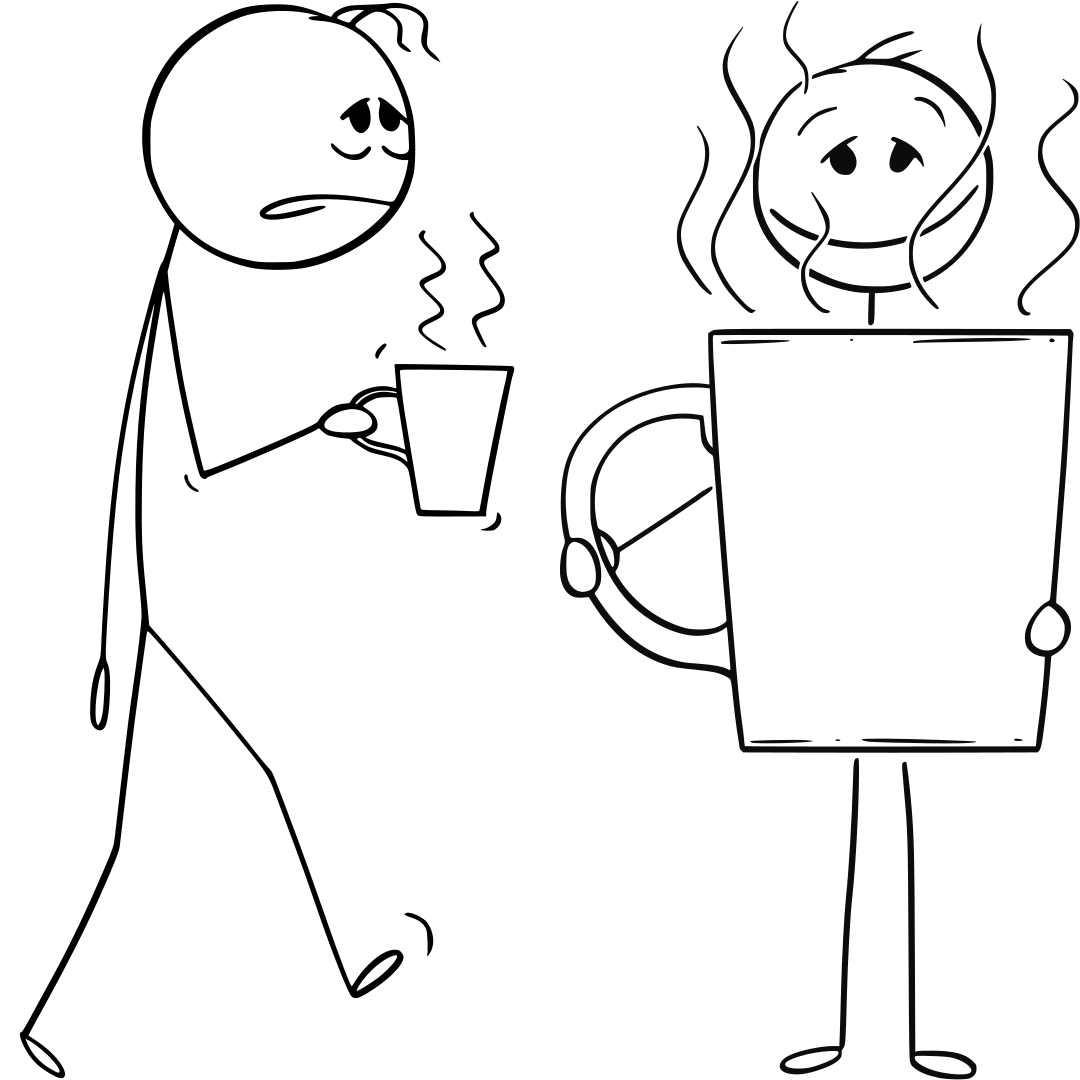
Let’s follow the trek of “Maria,” an every-person navigating a typical day. Maria wakes, coffee in hand, engaging her frontal lobe to plan her schedule. She remembers a friend’s birthday—thank you, hippocampus!—composes a text (language centers whirring), and feels a flush of affection (hello, amygdala).
Later, Maria is stressed at work—a symphony of stress hormones and heightened vigilance, an ancient circuit evolved for survival now repurposed for email overload. That mix of cognition and emotion is on parade from dawn to dusk.
But suppose Maria had a minor stroke that affected her Broca’s area. Suddenly, language production becomes laborious, though comprehension remains. Maria’s intelligence is untouched, but expression—communication, self-advocacy—demands new strategies and courage. Here, cognitive rehabilitation steps in: speech exercises, technology aids, and, critically, a supportive environment.
Cross-Pollination: Lessons from Other Fields
The functioning of the brain isn’t just a neuroscientific curiosity—it bears lessons for education, business, sports, and the arts. Athletes harness “visualization,” a cognitive trick that primes neural circuits for optimal performance. Educators craft curricula that respect working memory’s limitations. Musicians train their brains for feats of recall and split-second anticipation. Even artificial intelligence (yes, the irony isn’t lost here) borrows heavily from our neural architecture—neurons, synaptic weights, layers—to solve problems, categorize images, and “learn” from experience.
The Edge Cases: When Cognition Surprises Us
Because we promised to get into the weeds, let’s consider some stranger cases. There’s “blindsight”—where people, blind due to brain injury, nevertheless navigate obstacles with uncanny accuracy. Or “split-brain” patients, whose two hemispheres act almost independently after the corpus callosum is severed. Here, tests reveal one hand may choose a shirt, while the other picks a different one—two wills in a single skull. These outliers show just how adaptive, but also how modular and puzzling, the brain can be.
The Future of Brain Sciences: What If?
What if, someday, we could map every connection in a person’s brain?
What if we could boost attention or creativity with a morning “neurostimulation” session, or restore lost memories through carefully designed protein therapies? The ethical questions are as thrilling as the technical ones. If cognition could be enhanced, who gets access—and for what purpose? What happens to our sense of self if our brains become modifiable in real time?
Neuroethics, a fusion of philosophy, law, neuroscience, and technology, tackles these questions. The department at the University of Wit & Cheek, under the sage guidance of Dr. Lobo Frontal and colleagues, regularly debates the implications over robust cups of coffee and even more robust puns.
The Human Element: Why Cognition Matters
In the end, the story of the brain is personal. It’s the mother who forgets her son’s name yet still lights up at his touch. The accident survivor who, through grit and therapy, reclaims lost abilities. It’s the student staying up late to puzzle through a tangled math problem, the artist wrestling meaning from blank canvas.
Appreciating the marvels (and flaws) of your own cognition is as vital as any life skill. It’s recognizing that a bad day of focus might be the result of stress, not some deeper deficiency. It’s talking about mental health as openly as physical health. Every lapse, every spark of insight, every word uttered or dream chased—these are testaments to a machine more remarkable than any other: your brain.
A Call to Curiosity (and Action)
So the next time you misplace your keys, don’t just grumble; marvel at the billions of processes humming in your head that usually get it right. Share what you’ve learned here with a friend, reflect on your own cognitive trek, or simply pause in awe of the intricate, evolving symphony between your ears.
Want to hear about our PODCAST? Listen to Neuroplasticity: Podcast with Conrad and Valerie. Enjoy!! Stephanie
Further complementary resources for podcast
And for you nerds out there! Our Amazing Blog Series
We even have a quiz!!

Let’s talk podcast series, with hosts Conrad and Valerie, written by Stephanie Smith
With A little AI and OI @smithclinic.eng