
In the hallowed halls of the prestigious University of Wit & Cheek, a new study has emerged from the enigmatic Department of Redacted, courtesy of the equally mysterious Dr. Phil In-the-Blank. This groundbreaking research, shrouded in secrecy and liberal use of black marker, has set the academic world abuzz with speculation and raised eyebrows.
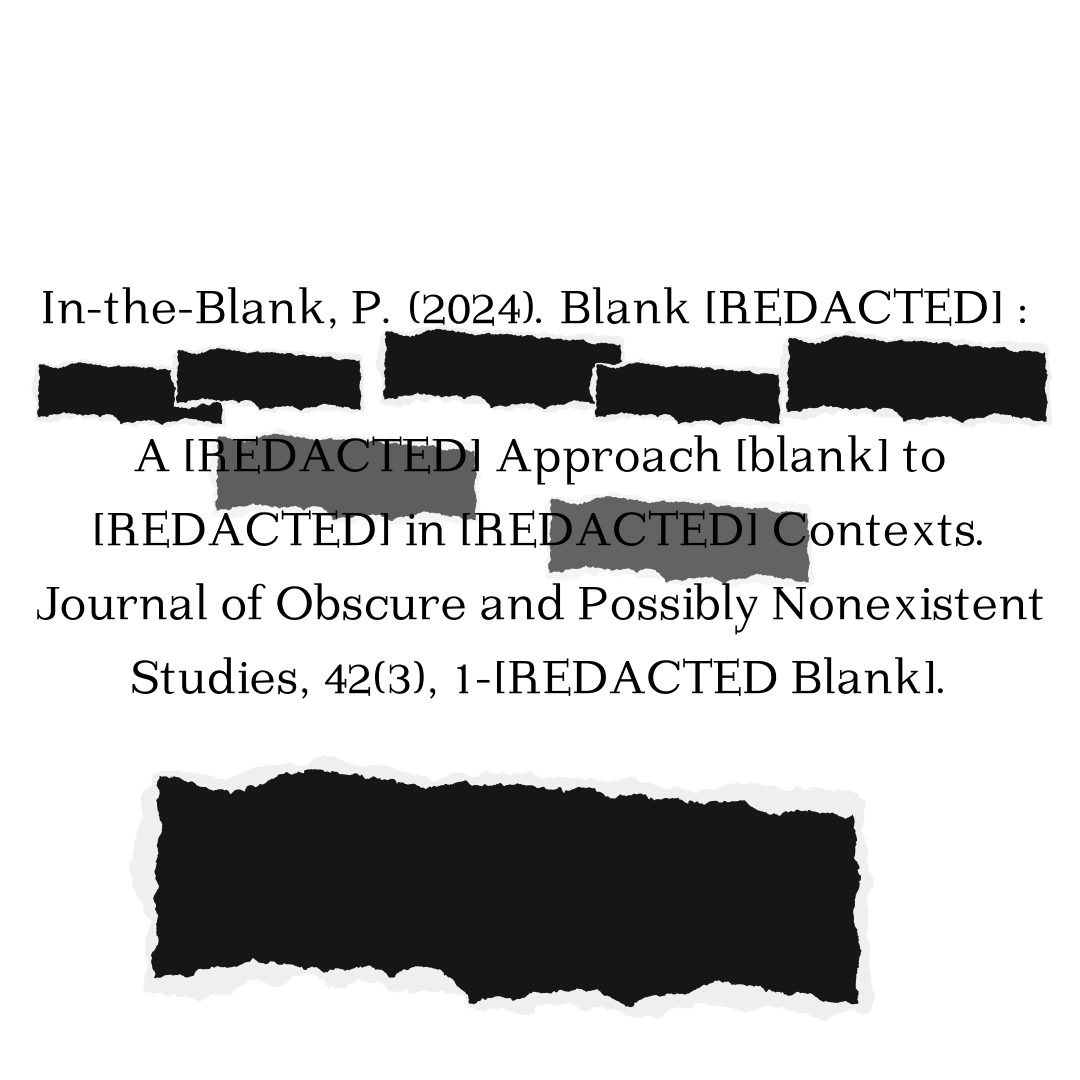
The study, titled “[Blank]: A Blank [REDACTED] Approach to [REDACTED] in [REDACTED] Contexts,” promises to revolutionize our understanding of… well, something. Possibly cognitive flexibility. Or perhaps it’s just an exceptionally well-disguised grocery list. The ambiguity is, one might argue, part of its charm.
Dr. (agent) In-the-Blank, known for his penchant for obscurity and his ability to turn simple sentences into cryptic puzzles, has outdone himself with this latest publication. The abstract, a masterpiece of academic obfuscation, reads as follows:
“This study examines the [REDACTED Blank] of [REDACTED] in relation to [REDACTED], with particular emphasis on [REDACTED] [Blankity Blank]. Our findings suggest a significant correlation between [REDACTED] and [REDACTED], which may have profound implications for [REDACTED].”
Intriguing, isn’t it? The methodology section, a tour de force of redaction, offers tantalizing glimpses into what might be a rigorous scientific process or possibly a recipe for a particularly complex casserole. It’s really anyone’s guess at this point.
Dr. Anima Collective, from the Department of Jung at the University of Wit & Cheek, offered her interpretation of the study: “Dr. In-the-Blank’s work is clearly a metaphor for the collective unconscious, where the redacted portions represent the shadow self we all possess. Or it could be about bananas. It’s hard to say with certainty.”
The results section, a veritable sea of black ink with occasional islands of legible text, has sparked heated debates in academic circles. Some scholars argue that the visible words “cognitive,” “flexibility,” and “unexpected turnip” point to groundbreaking discoveries in the field of neuroplasticity. Others contend that Dr. In-the-Blank simply spilled coffee on his shopping list.
Dr. Stubborn MacStubborn, from the Department of Wonderful Cognitive Flexibility and Adaptability, staunchly defends the former interpretation. “This is clearly a work of genius,” he insists. “The redactions themselves are a test of our cognitive flexibility. By forcing us to fill in the blanks, Dr. In-the-Blank is pushing the boundaries of our adaptive cognition. Also, I’m fairly certain page 17 is a sudoku puzzle.”
Critics, however, are less impressed. Dr. Sarcasm Dryly from the Department of Splash of Irony quipped, “Oh yes, nothing says ‘groundbreaking research’ quite like a paper that’s 90% blacked out. I’m sure the Nobel committee is scrambling to create a new category as we speak. Perhaps ‘Best Use of Redaction in a Scientific Paper’?”
Despite the controversy, or perhaps because of it, Dr. In-the-Blank’s research has garnered significant attention. The paper has been cited an impressive [REDACTED] times, although it’s unclear whether these citations are in earnest or simply other academics playing along with the joke.
In a rare interview, Dr. In-the-Blank shed some light on his unconventional approach: “The essence of [REDACTED Blank Blank Blank] lies in [Blank 4 REDACTED]. By [REDACTED], we can [REDACTED] the very nature of [REDACTED].” When pressed for clarification, he simply smiled enigmatically and offered the interviewer a turnip.
The implications of this study, whatever they may be, are far-reaching. Dr. Impulsive Decision from the Department of Neuroscientists believes the research could revolutionize our understanding of decision-making processes. “The way Dr. In-the-Blank has [Blank Blank Blank Blank Blank Blank][REDACTED] the [REDACTED] clearly demonstrates how [REDA Blank CTED] influences our choices. It’s brilliant, really. Or completely nonsensical. I haven’t decided yet.”
As the academic community grapples with the meaning (or lack thereof) of Dr. In-the-Blank’s work, one thing is clear: this study has certainly challenged our cognitive flexibility. Whether by design or happy accident, it has forced us to think outside the box, fill in the blanks, and question our assumptions about what constitutes valid research.
Dr. Paradigm Shift from the Systemic Family Therapy Department sees the study as a metaphor for family dynamics. “The redactions represent the secrets we keep from one another,” he muses. “By acknowledging the gaps in our knowledge, we open ourselves up to deeper understanding and connection. Or maybe it’s just a really complicated way to remember to buy milk. Both interpretations are equally valid in family therapy.”
As we conclude our exploration of Dr. Phil In-the-Blank’s latest research, we are left with more questions than answers. Is this a groundbreaking study on cognitive flexibility? A clever commentary on the state of academic publishing? An elaborate grocery list? Or perhaps all of the above?
In the end, the true genius of Dr. In-the-Blank’s work may lie in its ability to be all things to all people. Like a Rorschach test rendered in black marker, it invites us to project our own meanings onto its redacted surface. And in doing so, it challenges us to embrace ambiguity, exercise our cognitive flexibility, and perhaps even chuckle at the absurdities of academic life.
As Dr. In-the-Blank himself might say, “The [Blankity Blank] is in the eye of the [REDACTED].” Truer words have never been so thoroughly blacked out or blankity blanked.
[brownie points to anyone would immediately can visualize the blankity blank reference, and yes I am aware that it’s spelt wrong.]
References
Smith, Stephanie Joy. “Unraveling the Mystery: Dr. Phil In-the-Blank’s Latest Research – A Study in Redaction and Cognitive Flexibility (Or Perhaps Just Groceries).” Published at Smith Clinic, Editor by Stephanie at Chaos & Shoes, 2024.
In-the-Blank, P. (2024). [REDACTED]: A Blank and [REDACTED] Approach [blank] to [REDACTED] in [REDACTED] Contexts. Journal of Obscure and Possibly Nonexistent Studies, 42(3), 1-[REDACTED Blank].
References
Smith, Stephanie Joy. “Unraveling the Mystery: Dr. Phil In-the-Blank’s Latest Research – A Study in Redaction and Cognitive Flexibility (Or Perhaps Just Groceries).” Published at Smith Clinic, Editor by Stephanie at Chaos & Shoes, 2024.
In-the-Blank, P. (2024). [REDACTED]: A [REDACTED] Approach to [REDACTED] in [REDACTED] Contexts. Journal of Obscure and Possibly Nonexistent Studies, 42(3), 1-[REDACTED].
Kemp, C., Perfors, A., & Tenenbaum, J. B. (2007). Learning overhypotheses with hierarchical Bayesian models. Developmental Science, 10(3), 307-321.
Gallagher, S. (2009). Delusional realities. In M. R. Broome & L. Bortolotti (Eds.), Psychiatry as Cognitive Neuroscience: Philosophical Perspectives (pp. 245-266). Oxford University Press.
Winnicott, D. W. (1953). Transitional objects and transitional phenomena—a study of the first not-me possession. International Journal of Psycho-Analysis, 34, 89-97.
https://en.wikipedia.org/wiki/Blankety_Blank
https://philpapers.org/archive/KEESTS.pdf
https://link.springer.com/article/10.1007/s11065-024-09638-2
https://www.frontiersin.org/journals/psychology/articles/10.3389/fpsyg.2017.01040/full


By Stephanie with AI & OI
from the University of Wit & Cheek.
Notice Title
Dr. Phil In-the-Blank’s Initial interview or his debate on the DSM V | ICD 11.
