

Testing and Evaluations Blog Series
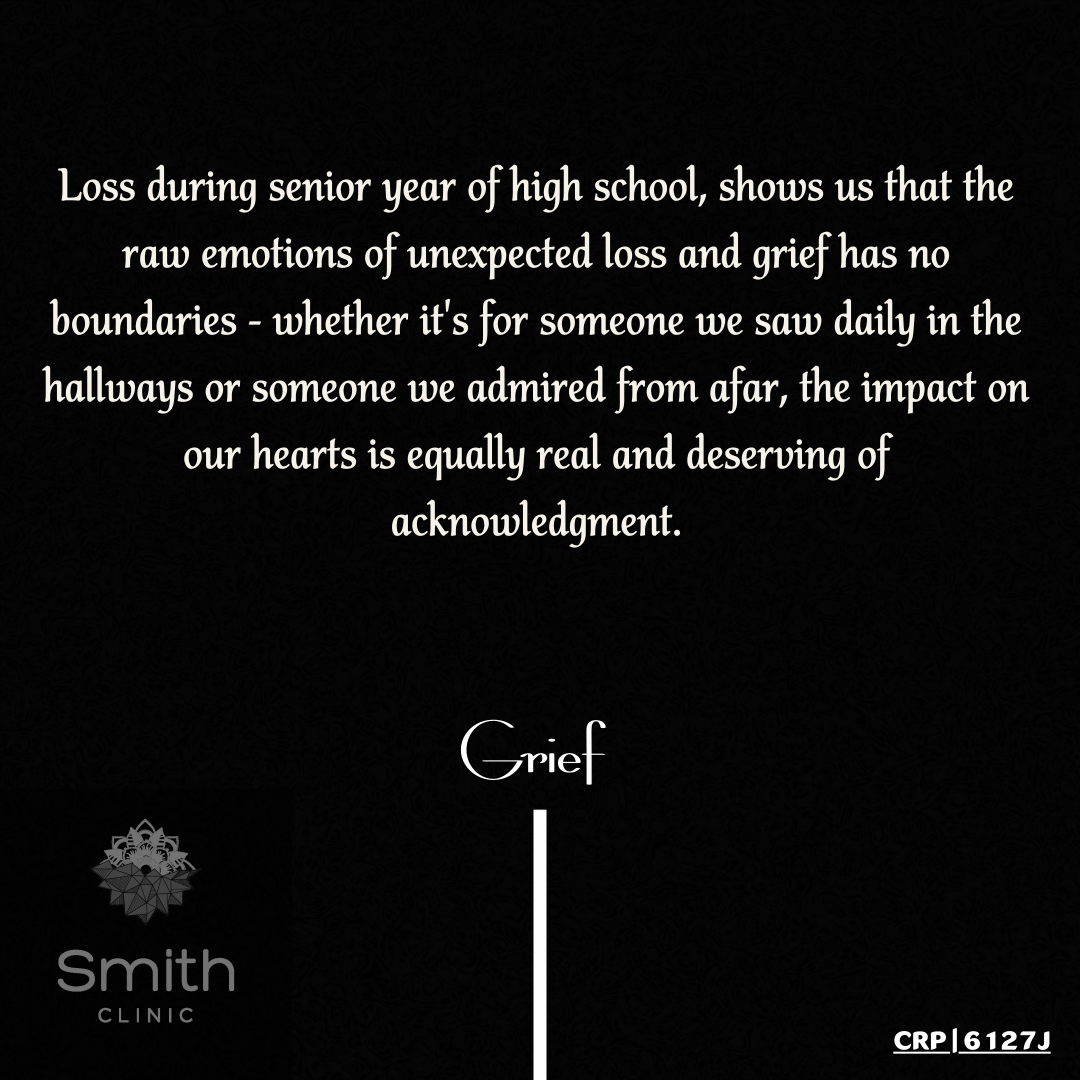
The sudden loss of a peer during adolescence creates a unique psychological wound that challenges our fundamental understanding of mortality and justice. As a neuropsychologist working with adolescents, I have witnessed how the death of a friend, particularly in tragic circumstances, can shatter the perceived invulnerability that typically characterizes teenage years.

The Unique Nature of Adolescent Peer Loss
When adolescents lose a peer, especially in sudden or tragic circumstances, they experience a profound disruption to their developmental trajectory. The loss forces them to confront their own mortality at a time when they typically feel invincible. This confrontation with mortality often leads to a pervasive sense of purposelessness, as their ambitions and idealism suddenly seem futile.
Neuropsychological Impact and Identity Formation
The death of a peer during adolescence affects three critical areas: self-esteem, identity formation, and emotional protective functions. These impacts are particularly severe because peer relationships play a central role in adolescent development. The sudden removal of a significant peer relationship can destabilize an adolescent’s entire sense of self and security in the world.
The Complexity of Grief Response
Adolescents experiencing peer loss often exhibit complex grief reactions that manifest differently from adult grief. They may experience intense emotional flooding, including shock, disbelief, and a deep sense of injustice. The grief process becomes particularly complicated when the death involves tragic circumstances or affects multiple members of their social circle.
Academic and Social Implications
The impact of peer loss frequently extends into academic performance and social functioning. Many adolescents experience a decrease in school success, increased stress, and potential depression. These academic challenges often stem from cognitive disruptions caused by grief, making it difficult to concentrate and maintain previous performance levels.
The Role of Survivor’s Guilt
A particularly challenging aspect of peer loss is the emergence of survivor’s guilt. Adolescents often struggle with intense feelings of responsibility or regret, questioning why they survived when their friend did not. This psychological burden can manifest in various ways, from withdrawal from social activities to obsessive rumination about the circumstances of the death.
Developmental Manifestations
The grief response in adolescents shows unique developmental manifestations. They may experience identity discontinuity, feeling markedly different from their peers and self-conscious about their loss experience. Some adolescents might resist forming new relationships, expressing fears about experiencing another loss.
The Impact on Family Systems
When a peer’s death affects multiple families, particularly in school communities, the ripple effects can be profound. Parents may become hyper-vigilant about their own children’s safety, while adolescents might feel increased pressure to protect their parents from additional worry. This dynamic can create a complex interplay of protective behaviors and emotional suppression.
Long-term Psychological Implications
Research indicates that the sudden death of a peer during adolescence can have lasting psychological effects extending into adulthood. However, with appropriate support and intervention, many adolescents can experience post-traumatic growth, finding meaning and personal development through their grief journey.
Therapeutic Approaches and Support Systems
Professional support becomes crucial when helping adolescents navigate peer loss. The therapeutic approach must acknowledge the unique developmental stage of adolescence while providing space for processing complex emotions. Group support can be particularly beneficial, as it allows adolescents to connect with others who understand their experience.
The Role of Communication
Effective communication becomes vital in supporting bereaved adolescents. They often struggle with expressing their grief, particularly when adults fail to recognize the significance of peer relationships. Creating safe spaces for open dialogue about their loss experiences can help prevent complicated grief reactions.
Conclusion
The death of a peer during adolescence represents a unique form of loss that requires specialized understanding and support. As mental health professionals, we must recognize the profound impact of such losses on adolescent development while providing appropriate interventions that honor their grief journey. Through understanding and support, we can help adolescents navigate this challenging experience while fostering resilience and growth.
Our hearts and thoughts are with all the friends and families affected by the tragic plane crash in southern Brazil yesterday, which claimed many lives.
References
https://www.compassionatefriends.org/grief/
https://smct.org.au/blog/how-to-support-grieving-adolescents
https://onlinegrad.syracuse.edu/blog/how-to-process-unexpected-death
https://griefsharing.ca/death-of-teenage
https://pmc.ncbi.nlm.nih.gov/articles/PMC8794619
https://uknowledge.uky.edu/cgi/viewcontent.cgi?article=1120&context=pediatrics_facpub
https://dergipark.org.tr/en/download/article-file/3509398
https://uknowledge.uky.edu/cgi/viewcontent.cgi?article=1120&context=pediatrics_facpub https://pmc.ncbi.nlm.nih.gov/articles/PMC8794619/
https://pmc.ncbi.nlm.nih.gov/articles/PMC3384440
https://www.mhanational.org/bereavement-and-grief
https://injoser.joln.org/index.php/123/article/download/142/180
https://scholarworks.waldenu.edu/cgi/viewcontent.cgi?article=16204&context=dissertations
https://www.nctsn.org/sites/default/files/resources/sibling_death_and_childhood_traumatic_grief_families.pdf
Brent, D., Melhem, N., Donohoe, M. B., & Walker, M. (2009). The incidence and course of depression in bereaved youth 2 months after the loss of a parent to suicide, accident, or sudden natural death. American Journal of Psychiatry, 166(7), 786-794. https://doi.org/10.1176/appi.ajp.2009.08081244
Burns, M., Griese, B., King, S., & Talmi, A. (2020). Childhood bereavement: Understanding prevalence and related adversity in the United States. American Journal of Orthopsychiatry, 90(4), 391-405. https://doi.org/10.1037/ort0000442
Cerel, J., Fristad, M. A., Verducci, J., Weller, R. A., & Weller, E. B. (2006). Childhood bereavement: Psychopathology in the 2 years postparental death. Journal of the American Academy of Child & Adolescent Psychiatry, 45(6), 681-690. https://doi.org/10.1097/01.chi.0000215327.58799.05
Dillen, L., Fontaine, J. R., & Verhofstadt-Denève, L. (2009). Confirming the distinctiveness of complicated grief from depression and anxiety among adolescents. Death Studies, 33(5), 437-461. https://doi.org/10.1080/07481180902805673
Flemming, S. J., & Adolph, R. (1986). Helping bereaved adolescents: Needs and responses. In C. A. Corr & J. N. McNeil (Eds.), Adolescence and death (pp. 97-118). Springer.
Guldin, M. B., Li, J., Pedersen, H. S., Obel, C., Agerbo, E., Gissler, M., Cnattingius, S., Olsen, J., & Vestergaard, M. (2015). Incidence of suicide among persons who had a parent who died during their childhood: A population-based cohort study. JAMA Psychiatry, 72(12), 1227-1234. https://doi.org/10.1001/jamapsychiatry.2015.2094
Guzzo, K. B., & Gobbi, P. E. (2023). Prevalence and correlates of childhood bereavement in the United States. Journal of Family Issues, 44(4), 1059-1084. https://doi.org/10.1177/0192513X211069062
Hill, R. M., Kaplow, J. B., Oosterhoff, B., & Layne, C. M. (2019). Understanding grief reactions, thwarted belongingness, and suicide ideation in bereaved adolescents: Toward a unifying theory. Journal of Clinical Psychology, 75(4), 780-793. https://doi.org/10.1002/jclp.22731
Hillis, S. D., Unwin, H. J. T., Chen, Y., Cluver, L., Sherr, L., Goldman, P. S., Ratmann, O., Donnelly, C. A., Bhatt, S., Villaveces, A., Butchart, A., Bachman, G., Rawlings, L., Green, P., Nelson, C. A., & Flaxman, S. (2021). Global minimum estimates of children affected by COVID-19-associated orphanhood and deaths of caregivers: A modelling study. The Lancet, 398(10298), 391-402. https://doi.org/10.1016/S0140-6736(21)01253-8
Kaplow, J. B., Layne, C. M., Pynoos, R. S., Cohen, J. A., & Lieberman, A. (2012). DSM-V diagnostic criteria for bereavement-related disorders in children and adolescents: Developmental considerations. Psychiatry: Interpersonal and Biological Processes, 75(3), 243-266. https://doi.org/10.1521/psyc.2012.75.3.243
Kaplow, J. B., Saunders, J., Angold, A., & Costello, E. J. (2010). Psychiatric symptoms in bereaved versus nonbereaved youth and young adults: A longitudinal epidemiological study. Journal of the American Academy of Child & Adolescent Psychiatry, 49(11), 1145-1154. https://doi.org/10.1016/j.jaac.2010.08.004
Kentor, R. A., & Kaplow, J. B. (2020). Supporting children and adolescents following parental bereavement: Guidance for health-care professionals. The Lancet Child & Adolescent Health, 4(12), 889-898. https://doi.org/10.1016/S2352-4642(20)30184-X
Keyes, K. M., Pratt, C., Galea, S., McLaughlin, K. A., Koenen, K. C., & Shear, M. K. (2014). The burden of loss: Unexpected death of a loved one and psychiatric disorders across the life course in a national study. American Journal of Psychiatry, 171(8), 864-871. https://doi.org/10.1176/appi.ajp.2014.13081132
Layne, C. M., Kaplow, J. B., & Youngstrom, E. A. (2017). Applying evidence-based assessment to childhood trauma and bereavement: Concepts, principles, and practices. In M. A. Landolt, M. Cloitre, & U. Schnyder (Eds.), Evidence-based treatments for trauma related disorders in children and adolescents (pp. 67-96). Springer.
Lerner, R. M., Tirrell, J. M., Dowling, E. M., Geldhof, G. J., Gestsdóttir, S., Lerner, J. V., King, P. E., Williams, K., Iraheta, G., & Sim, A. T. (2019). The end of the beginning: Evidence and absences studying positive youth development in a global context. Adolescent Research Review, 4(1), 1-14. https://doi.org/10.1007/s40894-018-0093-4
Melhem, N. M., Moritz, G., Walker, M., Shear, M. K., & Brent, D. (2007). Phenomenology and correlates of complicated grief in children and adolescents. Journal of the American Academy of Child & Adolescent Psychiatry, 46(4), 493-499. https://doi.org/10.1097/chi.0b013e31803062a9
Myers-Coffman, K., Baker, F. A., Daly, B. P., Palisano, R., & Bradt, J. (2019). The resilience songwriting program for adolescent bereavement: A mixed methods exploratory study. Journal of Music Therapy, 56(4), 348-380. https://doi.org/10.1093/jmt/thz011
Oosterhoff, B., Kaplow, J. B., & Layne, C. M. (2018). Trajectories of binge drinking differentially mediate the association between adolescent dating violence victimization and psychological distress in adulthood. Addictive Behaviors, 85, 175-181. https://doi.org/10.1016/j.addbeh.2018.06.011
Pynoos, R. S., Steinberg, A. M., & Wraith, R. (2014). A developmental model of childhood traumatic stress. In D. Cicchetti & D. J. Cohen (Eds.), Developmental psychopathology: Risk, disorder, and adaptation (pp. 72-95). John Wiley & Sons.
Spuij, M., Reitz, E., Prinzie, P., Stikkelbroek, Y., de Roos, C., & Boelen, P. A. (2012). Distinctiveness of symptoms of prolonged grief, depression, and post-traumatic stress in bereaved children and adolescents. European Child & Adolescent Psychiatry, 21(12), 673-679. https://doi.org/10.1007/s00787-012-0307-4
Other reads about Grief

The Testing and Evaluations Blog Series by Stephanie
With A little AI and OI | @smithclinic.eng

