

The ADHD blog series
Due to popular demand I have added a TLTR summary.
Or another version
Summary TLTR
Individuals with ADHD experience a “time warp” due to altered time perception, impacting daily functioning and quality of life. Neuroimaging studies link this phenomenon to deficits in specific brain regions associated with ADHD symptoms. While current treatments focus on symptom management, research suggests targeted interventions addressing temporal processing deficits could be beneficial.
Key Points TLTR
Time Perception in ADHD: Individuals with ADHD experience a “warped sense of time,” manifesting in underestimating time during engaging activities and struggling with time management.
Neurobiological Basis: Neuroimaging studies link time perception deficits in ADHD to altered activity in brain regions associated with temporal processing, including the prefrontal cortex, anterior cingulate, and supplementary motor area.
Research Findings: A meta-analysis by Marx et al. (2021) found consistent deficits in various timing abilities among individuals with ADHD, including time discrimination, estimation, production, and reproduction tasks.
Time Perception in ADHD: Individuals with ADHD experience a “myopia to impending future events,” struggling with planning and future-oriented behaviors.
Impact of Time Distortions: Time perception deficits in ADHD can significantly affect academic and occupational functioning, social relationships, and overall quality of life.
Clinical Implications: Understanding the role of time perception in ADHD can inform diagnostic processes and treatment approaches, potentially leading to more personalized treatment strategies.
Treatment Focus: Current ADHD treatments primarily manage symptoms through medication and behavioral strategies.
Time Perception Interventions: Cognitive training programs show promise in improving time estimation and management skills for individuals with ADHD.
Future Research Directions: Future research should focus on developing ecologically valid measures of time perception, examining the developmental trajectory of temporal processing abilities, and investigating the intersection of time perception with other cognitive domains.
ADHD Time Warp Significance: Represents a fundamental aspect of ADHD with implications for diagnosis, treatment, and daily functioning.
Time Perception Research Importance: Offers insights into the cognitive and neural mechanisms underlying ADHD.
Future Research Potential: Leads to targeted interventions and a more comprehensive understanding of ADHD.

Clinical Insights Blog Series
ADHD Time Perception: Understanding the Neurological Basis of Temporal Distortions
The concept of time, a fundamental aspect of human experience, takes on a peculiar dimension for individuals with Attention Deficit Hyperactivity Disorder (ADHD). The phenomenon colloquially known as the “ADHD time warp” has long intrigued clinicians and researchers alike, prompting a deeper exploration into the neurological underpinnings of temporal perception in ADHD. This article delves into the latest research on time perception in ADHD, examining its neurobiological basis, clinical implications, and potential therapeutic approaches.
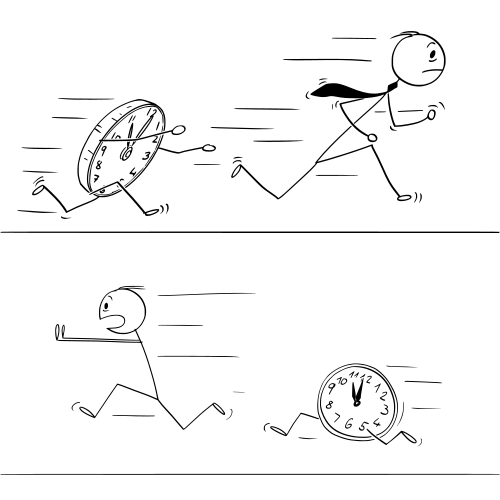
Time perception, a cognitive process often taken for granted, plays a crucial role in our daily functioning.
For individuals with ADHD, however, this process can be significantly altered, leading to what many describe as a warped sense of time. This distortion can manifest in various ways, from underestimating the passage of time during engaging activities to struggling with time management and punctuality.
Recent neuroimaging studies have shed light on the neural correlates of time perception in ADHD. Research has consistently implicated several brain regions in temporal processing, including the prefrontal cortex, anterior cingulate, and supplementary motor area. Interestingly, these are the same regions often associated with the core symptoms of ADHD, suggesting a neurobiological link between time perception deficits and the disorder’s primary manifestations.
A meta-analysis conducted by Marx et al. (2021) provides compelling evidence for altered perceptual timing abilities in ADHD. The study, which analyzed data from 55 studies with a combined total of over 2,000 participants, found consistent deficits across various timing paradigms. Individuals with ADHD demonstrated impairments in time discrimination, estimation, production, and reproduction tasks, with effect sizes ranging from small to medium.
These findings align with the theoretical framework proposed by Russell Barkley, Ph.D., a leading researcher in the field of ADHD. Barkley posits that individuals with ADHD experience a “myopia to impending future events,” effectively splitting time into two categories: “now” and “not now”. This temporal myopia may explain why individuals with ADHD often struggle with planning and future-oriented behaviors, as the future remains nebulous and difficult to conceptualize.
The impact of these temporal distortions extends far beyond mere inconvenience. Time perception deficits can significantly affect academic and occupational functioning, social relationships, and overall quality of life. For instance, a study by Weissenberger et al. (2020) found that adults with ADHD symptoms were more likely to exhibit a present hedonistic time perspective, as measured by the Zimbardo Time Perspective Inventory (ZTPI). This orientation towards immediate gratification may contribute to impulsive decision-making and difficulties in long-term planning.
Moreover, the “ADHD time warp” phenomenon can manifest as hyperfocus, a state of intense concentration on a single task to the exclusion of all else. While hyperfocus can be advantageous in certain situations, it can also lead to significant time management issues when individuals lose track of hours spent on a particular activity.
The clinical implications of these findings are substantial. Understanding the role of time perception in ADHD can inform diagnostic processes and treatment approaches. For instance, Marx et al. (2021) suggest that timing tasks could be incorporated into clinical assessments to better characterize the patient’s profile. This approach could potentially lead to more personalized treatment strategies that address specific temporal processing deficits.
Current therapeutic approaches for ADHD primarily focus on symptom management through pharmacological interventions and behavioral strategies. However, the growing body of research on time perception in ADHD suggests that targeted interventions addressing temporal processing deficits may be beneficial. Cognitive training programs aimed at improving time estimation and management skills have shown promise in preliminary studies, though more research is needed to establish their long-term efficacy.
Pharmacological interventions, particularly stimulant medications, have been shown to normalize some aspects of time perception in individuals with ADHD. A study by Noreika et al. (2013) found that methylphenidate administration led to improvements in time discrimination tasks. These findings suggest that the dopaminergic system, which is modulated by stimulant medications, plays a crucial role in temporal processing.
Despite these advances, several challenges remain in the study and treatment of time perception deficits in ADHD. The heterogeneity of ADHD presentations and the complexity of temporal processing mechanisms make it difficult to develop one-size-fits-all interventions. Additionally, the subjective nature of time perception poses methodological challenges in research settings.
Future research directions should focus on developing more ecologically valid measures of time perception that reflect real-world functioning. Longitudinal studies examining the developmental trajectory of temporal processing abilities in ADHD could provide valuable insights into the disorder’s progression and inform early intervention strategies.
Furthermore, the intersection of time perception and other cognitive domains, such as working memory and attention, warrants further investigation. Understanding these relationships could lead to more comprehensive models of cognitive functioning in ADHD and inform the development of integrated treatment approaches.
The concept of the “ADHD time warp” extends beyond a mere curiosity, representing a fundamental aspect of the disorder with far-reaching implications for diagnosis, treatment, and daily functioning. As our understanding of the neurobiological basis of time perception in ADHD continues to evolve, so too does the potential for developing targeted interventions that address this core deficit.
In conclusion, the study of time perception in ADHD offers a unique window into the cognitive and neural mechanisms underlying the disorder. By unraveling the complexities of the ADHD time warp, researchers and clinicians can work towards more effective strategies for managing the temporal challenges faced by individuals with ADHD. As we continue to explore this fascinating aspect of cognition, we move closer to a more comprehensive understanding of ADHD and, ultimately, to more effective ways of supporting those affected by the disorder.
References
1. Weissenberger, S., Klicperova-Baker, M., Zimbardo, P., Schonova, K., Akotia, D., Kostal, J., Goetz, M., Raboch, J., & Ptacek, R. (2019). ADHD and Present Hedonism: Time Perspective as a Potential Diagnostic and Therapeutic Tool. Neuropsychiatric Disease and Treatment, 15, 1349-1360.
2. Noreika, V., Falter, C. M., & Rubia, K. (2013). Timing deficits in attention-deficit/hyperactivity disorder (ADHD): Evidence from neurocognitive and neuroimaging studies. Neuropsychologia, 51(2), 235-266.
3. Marx, I., Cortese, S., Koelch, M. G., & Hacker, T. (2021). Meta-analysis: Altered Perceptual Timing Abilities in Attention-Deficit/Hyperactivity Disorder. Journal of the American Academy of Child and Adolescent Psychiatry, published online.
4. Noreika, V., Falter, C. M., & Rubia, K. (2013). Timing deficits in attention-deficit/hyperactivity disorder (ADHD): Evidence from neurocognitive and neuroimaging studies. Neuropsychologia, 51(2), 235-266.
5. Weissenberger, S., Ptacek, R., Klicperova-Baker, M., Erman, A., Schonova, K., Raboch, J., & Goetz, M. (2017). ADHD, Lifestyles and Time Perspectives: Evidence from the Czech Republic. Neuropsychiatric Disease and Treatment, 13, 2255-2267.
6. Barkley, R. A. (2016). Managing Time and Time Perception in ADHD. ADHD Report, 24(1), 1-5.
7. Weissenberger, S., Klicperova-Baker, M., Zimbardo, P., Schonova, K., Akotia, D., Kostal, J., Goetz, M., Raboch, J., & Ptacek, R. (2020). ADHD Symptoms in Adults and Time Perspectives – Findings From a Czech National Sample. Frontiers in Psychology, 11, 950.
8. Shaw, P., Eckstrand, K., Sharp, W., Blumenthal, J., Lerch, J. P., Greenstein, D., Clasen, L., Evans, A., Giedd, J., & Rapoport, J. L. (2007). Attention-deficit/hyperactivity disorder is characterized by a delay in cortical maturation. Proceedings of the National Academy of Sciences, 104(49), 19649-19654.
9. Valko, L., Schneider, G., Doehnert, M., Müller, U., Brandeis, D., Steinhausen, H. C., & Drechsler, R. (2010). Time processing in children and adults with ADHD. Journal of Neural Transmission, 117(10), 1213-1228.
Clinical Implications of the Perception of Time in Attention Deficit … https://pmc.ncbi.nlm.nih.gov/articles/PMC6556068/
Time Management and ADHD: Tips for Success | Psych Central https://psychcentral.com/adhd/time-management-tips-for-people-with-adhd
Meta-analysis finds consistent time perception impairments in … https://www.adhdevidence.org/blog/time-blindness-found-to-be-a-consistent-feature-of-adhd
Time Perception is a Focal Symptom of Attention-Deficit … https://pmc.ncbi.nlm.nih.gov/articles/PMC8293837/
Time Perception in Adult ADHD: Findings from a Decade—A Review https://pmc.ncbi.nlm.nih.gov/articles/PMC9962130/
Wasting Time? Hyperfocusing? ADHD and Time Perception Problems https://www.additudemag.com/wasting-time-adhd-and-time-perception/
ADHD Symptoms in Adults and Time Perspectives – Frontiers https://www.frontiersin.org/journals/psychology/articles/10.3389/fpsyg.2020.00950/full
[PDF] Developments and challenges in the diagnosis and treatment of … https://www.scielo.br/j/rbp/a/nPQwCzSYDm3KThj3HSjGXXx/?format=pdf&lang=en
[PDF] Original article – ADHD prevalence estimates across three decades … https://www.cursosbayleybrasil.com.br/_files/ugd/29b632_895ffb23eb61413ea613f53074a5780c.pdf?index=true

The ADHDers Blog Series by Stephanie An ADHDers herself and parent to ADHDERS as well.
With A little AI and OI @smithclinic.eng

