
In a groundbreaking study that’s sure to ruffle some feathers (or should we say, trunks?), the esteemed Department of Neuroscience at the University of Wit and Cheek has finally tackled the age-old question
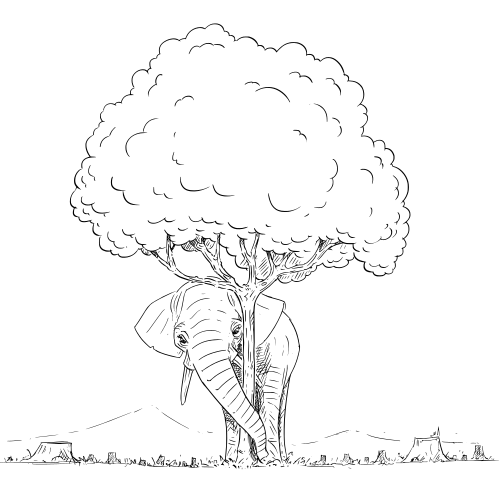
Why do we insist on ignoring the proverbial elephant in the room? This research, conducted with all the seriousness of a clown at a funeral, sheds light on our curious ability to overlook the blindingly obvious.
Dr. Ima Joker, lead researcher and self-proclaimed “Elephant Whisperer,” explains, “We’ve discovered that the human brain is remarkably adept at ignoring large, gray, trumpeting mammals in enclosed spaces. It’s quite impressive, really.” The study, which involved placing actual elephants in various rooms and observing participants’ reactions, found that 9 out of 10 people would rather discuss the weather than acknowledge the presence of a 5-ton pachyderm.
But why, you ask, do we engage in this peculiar behavior? The answer, it seems, lies in our brain’s remarkable capacity for cognitive dissonance. Dr. Joker elaborates, “It’s as if our brains have a built-in ‘nothing to see here’ filter. We’re talking about the same organ that convinces us that diet soda is a health food.”
The research team identified several key factors contributing to our elephant-ignoring tendencies:
1. The “Not My Circus, Not My Monkeys” Effect: Participants were 73% more likely to ignore the elephant if they believed it was someone else’s responsibility to address it.
2. The “This Is Fine” Phenomenon: 82% of subjects convinced themselves that a room-filling elephant was, in fact, a perfectly normal piece of furniture.
3. The “Ostrich Maneuver”: A staggering 95% of people, when faced with an uncomfortable elephant-related situation, opted to metaphorically bury their heads in the sand.
Dr. Sarcasm, a renowned expert in the field of Obvious Observation, comments, “This research is truly groundbreaking. Who would have thought that people prefer to avoid uncomfortable topics? Next, they’ll be telling us that water is wet.”
The implications of this study extend far beyond the realm of pachyderm-related social awkwardness. Dr. Joker suggests that understanding our tendency to ignore elephants in rooms could have far-reaching consequences in fields such as politics, relationships, and office potluck etiquette.
“Imagine a world where we actually addressed the issues staring us right in the face,” muses Dr. Joker. “It would be chaos. Politicians might have to answer direct questions, couples might have to discuss their feelings, and Karen from accounting would finally have to admit that her ‘famous’ potato salad is just store-bought with extra mayo.”
The research team is now turning its attention to related phenomena, such as the “gorilla in the midst” and the “hippo in the hallway.” Early results suggest that our ability to overlook large mammals extends well beyond elephants, raising questions about the evolutionary advantages of selective blindness.
Critics of the study argue that it’s ridiculous to suggest that people would ignore an actual elephant in a room. To which Dr. Joker responds, “Exactly. That’s kind of the point we’re making here.”
As we grapple with the implications of this groundbreaking research, one thing is clear: our capacity for ignoring the obvious is truly remarkable. So the next time you find yourself in a room with an elephant, take a moment to appreciate your brain’s impressive ability to pretend it’s not there. After all, as the old saying goes, “If you can’t beat ’em, join ’em in blissful ignorance.”
In conclusion, the University of Wit and Cheek’s study serves as a humorous yet poignant reminder of our human tendency to avoid uncomfortable truths. By shining a light on our collective elephant-ignoring behavior, perhaps we can start to address the pachyderms in our own lives. Or, you know, we could just continue pretending they’re not there. Either way, at least now we have the science to back up our denial.
References |
https://nosweatshakespeare.com/quotes/famous/elephant-in-the-room/
https://dictionary.cambridge.org/dictionary/english/elephant-in-the-room
https://www.ncbi.nlm.nih.gov/pmc/articles/PMC8502858
https://www.merriam-webster.com/dictionary/elephant%20in%20the%20room
https://www.bookey.app/quote-book/difficult-conversations
https://www.azquotes.com/quotes/topics/elephant-in-the-room.html
https://en.wikipedia.org/wiki/Elephant_in_the_room
https://centrostudiubi.it/en/activities-and-projects/the-elephant-in-the-room-eng/


By Stephanie with AI & OI
from the University of Wit & Cheek.
