
The Delicate Dance of Discomfort with Professor Dryly
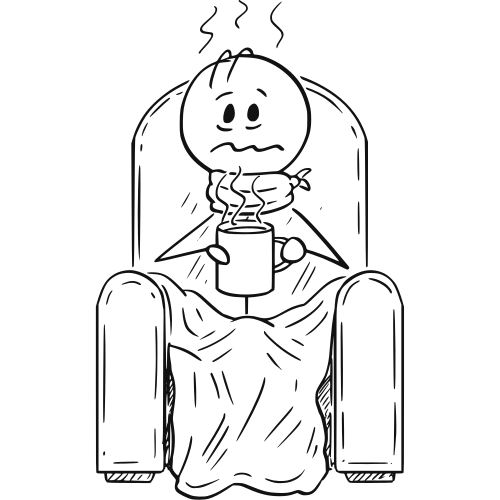
Professor Dryly’s Insights
In a world where wellness has become a competitive sport, the esteemed Professor Sarcasm Dryly from the University of Wit & Cheek’s Department of A Splash of Irony has unveiled his latest research on the oft-overlooked the art of being unwell and the role of well-meaning bystanders. This groundbreaking study, which promises to revolutionize our understanding of illness and social support – or at least provide a few chuckles along the way – delves into the intricate dance between those who are unwell and those who desperately want to help.
“We live in a world where being sick is an Olympic event, and offering unsolicited advice is the national pastime,” quips Professor Dryly, his eyebrow raised in a manner that suggests he finds the very idea both fascinating and mildly absurd. “That’s essentially what we’re dealing with here – a societal obsession with health that has turned illness into a personal failure and bystander intervention into an extreme sport.”
The professor’s research reveals some startling statistics about the impact of social support on mental health. According to a meta-analysis cited in his study, social support can significantly predict health outcomes, with a mean effect size of 0.330, indicating a moderate positive correlation between social support and mental health. “It’s almost as if human connection is good for us,” Professor Dryly muses. “Who would have thought?”
But the revelations don’t stop there. The study found that different types of social support have varying degrees of effectiveness. Emotional and informational support, along with positive social interactions, showed the strongest protective associations with depression, followed by tangible support. “It turns out that offering a shoulder to cry on and actually listening to someone’s problems is more effective than throwing money or casseroles at the situation,” Professor Dryly notes dryly. “Though I’m sure the casserole industry will be devastated by this news.”
The research also sheds light on the often-overlooked art of being unwell. Professor Dryly argues that there’s a certain skill to navigating illness in a society that values productivity above all else. “It’s like trying to perform a one-person show where you’re both the sick protagonist and the Greek chorus of well-wishers,” he explains. “And let’s not forget the costume changes between ‘I’m fine’ and ‘Please, for the love of all that is holy, leave me alone.'”
But what about the well-meaning bystanders? How can they navigate the treacherous waters of offering support without drowning the unwell person in a sea of good intentions? Professor Dryly’s research offers some insights. “First and foremost, resist the urge to play Doctor Google,” he advises. “Contrary to popular belief, WebMD is not a substitute for actual medical training, and your friend probably doesn’t have that rare tropical disease you just read about.”
Instead, the study suggests that effective emotional support involves empathizing and validating the other person’s experiences. “It’s about listening without judgment,” Professor Dryly explains. “Which, let’s face it, is about as easy as trying to herd cats while blindfolded.”
The research also highlights the importance of offering compassion and reassurance without minimizing the person’s struggles. “Telling someone to ‘just cheer up’ is about as effective as telling a fish to breathe air,” Professor Dryly quips. “It’s not only unhelpful, it’s also a great way to ensure you’re never invited to their pity party again.”
In conclusion, Professor Sarcasm Dryly’s latest research offers a fascinating – and slightly tongue-in-cheek – look at the complexities of being unwell and providing support as a bystander. As we navigate the often-murky waters of illness and social interaction, perhaps the most important lesson is that there’s no one-size-fits-all approach to offering support.
As the professor himself puts it, with a twinkle in his eye, “In the grand scheme of things, the art of being unwell is really about learning to accept help graciously, even when it comes in the form of terrible advice and questionable home remedies. And for the well-meaning bystanders, remember – sometimes the most helpful thing you can do is simply shut up and listen.”
So the next time you find yourself on either side of the illness equation, take heart. With a little wit, a dash of empathy, and a healthy dose of Professor Dryly’s sarcasm, you too can master the delicate dance of discomfort.
References
1. Harandi, T. F., Taghinasab, M. M., & Nayeri, T. D. (2017). The correlation of social support with mental health: A meta-analysis. Electronic physician, 9(9), 5212-5222.
2. Bhan, N., Hahn, Y., Patel, V., & Sudharsanan, N. (2023). Social support and depression during a global crisis. Nature Mental Health, 1(6), 403-414.
3. Legg, T. J. (2022, April 27). How to show emotional support: Tips and examples. Medical News Today.
4. Goodhousekeeping.com. (2024, August 13). 60 Powerful Mental Health Quotes to Inspire and Uplift You.
5. Mental Health Match. (n.d.). 101 Inspiring Mental Health Quotes.
https://pmc.ncbi.nlm.nih.gov/articles/PMC5633215
https://www.nature.com/articles/s44220-023-00078-0
https://www.medicalnewstoday.com/articles/emotional-support
https://mentalhealthmatch.com/articles/anxiety/inspiring-mental-health-quotes
https://www.goodhousekeeping.com/life/a39739060/mental-health-quotes
Smith, Stephanie Joy. (2024). “The Art of Being Unwell and How to Make Others Feel Better by Well-Meaning Bystanders.” Published at Smith Clinic, edited by Stephanie at Chaos & Shoes.
For more from Prof. Dryly’s view on pain, and cures click on the words to take you to the posts.
Enjoy


By Stephanie with AI & OI
from the University of Wit & Cheek.
