

The ADHD blog series
Part 10 of Our October ADHD Awareness Month Series
Previously, I listed some important dates but now I’m going to go into more detail about some interesting dates.
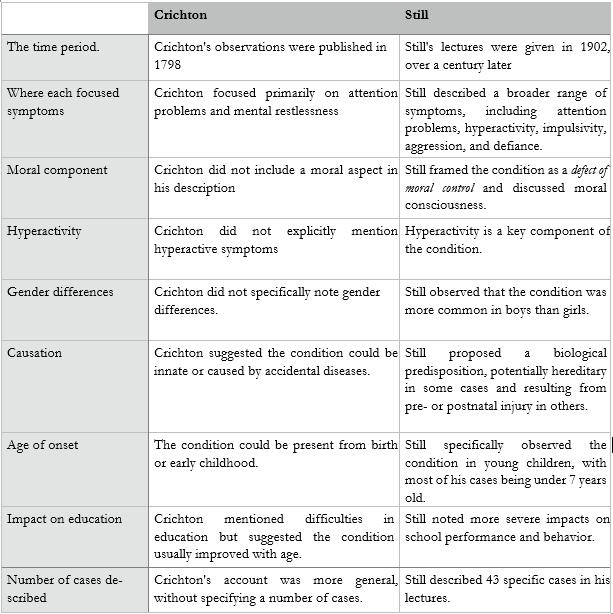
In 1798, Scottish physician Sir Alexander Crichton provided one of the earliest detailed descriptions of a condition resembling ADHD in his book An Inquiry into the Nature and Origin of Mental Derangement.
He referred to it as the disease of attention, observing that affected individuals seemed mentally restless and had difficulty sticking with tasks.
In the 1800s, medical textbooks referred to children with probable ADHD symptoms using various terms like nervous child, hypermetamorphosis, mental instability, unstable nervous system,” and simple hyperexcitability.
In 1844, German physician Heinrich Hoffmann wrote children’s stories about Fidgety Phil, depicting a child with symptoms resembling ADHD.
In 1899, Scottish psychiatrist Thomas Smith Clouston described a condition he called simple hyperexcitability in children.
Up to this point it was merely something that occurred in some children but in 1902 all this changed and turned a dark corner.
In 1902, British pediatrician Sir George Frederic Still published influential lectures describing a group of children with problems related to attention, self-regulation, aggression and defiance. He noted the condition affected more boys than girls. It was a defect of moral control.
Now this is where the moral defect starts to be used.
So what are the key differences between Crichton’s versus Still’s descriptions of what we now recognize as ADHD:

the Clinical Insights Blog by Stephanie and edited by Michael
With A little AI and OI | @smithclinic.eng

