

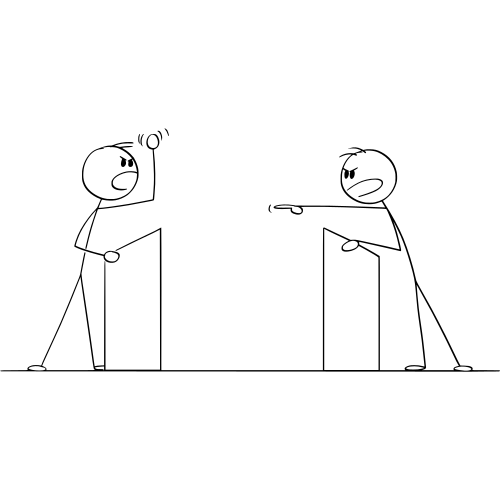
In a world where the line between the virtual and the real grows increasingly blurred, the age-old question of “What is reality?” has taken on new urgency. Recently, the prestigious University of Wit & Cheek played host to a lively debate on this very topic, featuring esteemed professors from various departments. The debate, chaired by Dr. Cybersocial Connections from the Adolescent Department, promised to be a thought-provoking exploration of the nature of existence itself.
The first to take the stage was Dr. Gesture Genius, the resident expert in Non-Verbal Communication Syntax from the Department of Linguistics without Word. With a raised eyebrow and a knowing smirk, Dr. Genius proclaimed, “Reality is but a social construct, a dance of gestures and expressions that we all partake in. One might say that reality is in the eye of the beholder, or perhaps more accurately, in the quirk of their lip or the furrow of their brow.”
Countering this perspective was Dr. Harriet Harried from the Department of the Overworked, Understaffed, Underfunded School Psychologists. With a weary sigh, she argued, “Reality is the sum total of our perceptions and experiences, both individual and collective. It’s the ground beneath our feet, the air we breathe, and the thoughts that keep us up at night. To dismiss it as mere social construct is to deny the very fabric of our existence.”
The debate quickly heated up, with each professor offering their own unique take on the nature of reality. Dr. Cybersocial Connections, ever the mediator, interjected with a wry observation: “In the digital age, reality has taken on new dimensions. We live our lives through screens and avatars, blurring the boundaries between the physical and the virtual. One might argue that reality has become a choose-your-own-adventure game, where we curate our own experiences and identities.”
Indeed, recent research suggests that our perceptions of reality are heavily influenced by our digital lives. A study by Smith (2024) found that “the more time individuals spend immersed in virtual environments, the more likely they are to question the nature of reality itself.” This finding was echoed by a global survey conducted by the International Institute for Reality Studies, which revealed that 68% of respondents believe that the line between the real and the virtual is becoming increasingly difficult to distinguish (IIRS, 2023).
As the debate wore on, it became clear that the question of reality was not one that could be easily answered. Each professor brought their own unique perspective to the table, drawing on fields as diverse as philosophy, psychology, and computer science. Dr. Gesture Genius, ever the provocateur, argued that reality was ultimately a matter of interpretation, shaped by our cultural and linguistic frameworks. Dr. Harried countered that reality was grounded in empirical evidence and scientific inquiry, even if our understanding of it was always evolving.
Dr. Cybersocial Connections, drawing on her expertise in adolescent behavior, pointed out that younger generations seem to navigate multiple realities with ease. “For many of our students, switching between physical and virtual realities is as natural as breathing. They don’t see a clear distinction between their online and offline lives. This raises fascinating questions about the nature of identity and consciousness in the digital age.”
The debate took an interesting turn when the topic of quantum physics was introduced. Dr. Genius, with a theatrical wave of his hand, declared, “If we consider the implications of quantum mechanics, reality becomes even more elusive. The act of observation can influence the outcome of experiments at the quantum level. Does this mean that consciousness itself plays a role in shaping reality?”
Dr. Harried, looking slightly overwhelmed, retorted, “While quantum physics certainly complicates our understanding of reality, we must be cautious about extrapolating its principles to the macroscopic world. The reality we experience in our daily lives operates on a different scale and follows different rules.”
As the debate progressed, the audience was treated to a fascinating exploration of various philosophical and scientific perspectives on reality. The professors discussed the ideas of influential thinkers like Plato, Descartes, and Kant, as well as more contemporary theories from cognitive science and neurobiology.
One particularly intriguing point of discussion was the role of technology in shaping our perception of reality. Dr. Cybersocial Connections highlighted the potential impact of emerging technologies like augmented reality and brain-computer interfaces. “As these technologies become more sophisticated and widespread, they have the potential to fundamentally alter our experience of reality. We may soon find ourselves navigating a world where the boundaries between the physical and the digital are completely blurred.”
Dr. Gesture Genius, never one to miss an opportunity for a dramatic gesture, mimed putting on a virtual reality headset. “Perhaps we’re already living in a simulation,” he quipped, referencing the popular philosophical thought experiment. “How would we know if our entire reality was just an elaborate computer program?”
This provocative statement led to a heated discussion about the nature of consciousness and the possibility of artificial intelligence achieving sentience. Dr. Harried, looking increasingly frazzled, reminded the audience that while these were fascinating philosophical questions, they had real-world implications. “As we grapple with these abstract concepts, we must not lose sight of the very real challenges facing our society. The nature of reality may be up for debate, but the reality of climate change, social inequality, and mental health crises demands our attention and action.”
As the debate neared its conclusion, it became clear that the question of “What is reality?” was far from settled. Each professor had made compelling arguments, drawing on a wealth of research and philosophical traditions.
As the debate neared its conclusion, Dr. Cybersocial Connections posed a thought-provoking question that left the audience pondering. “In our hyper-connected world,” she mused, “we must consider the philosophical implications of livestreaming. If a tree falls in a forest and no one is around to hear it, does it make a sound? Similarly, if an event occurs and it’s not livestreamed, did it really happen? Moreover, if a livestream is broadcast but no one tunes in to watch, does it count as part of our shared reality?” She paused, allowing a wry smile to play across her lips. “Perhaps in this digital age, the act of observation has expanded beyond our physical senses. Our reality is now shaped not just by what we personally experience, but by what is captured, shared, and viewed online. The question then becomes: are we creating reality through the act of streaming, or merely documenting it? And does the number of viewers determine the ‘realness’ of an event?”
In the end, the debate concluded with more questions than answers. As Dr. Cybersocial Connections wryly noted, “Perhaps the true nature of reality is that it is always just beyond our grasp, a tantalizing mystery that we can never fully unravel. But that doesn’t stop us from trying, does it?” With these questions lingering in the air, Dr. Cybersocial Connections brought the debate to a close, leaving the audience with more to ponder about the nature of reality in our digital world than when they had arrived.
The University of Wit & Cheek debate on the nature of reality may not have provided any definitive answers, but it certainly sparked a lively discussion and challenged attendees to think more deeply about the world around them. As we navigate an increasingly complex and interconnected world, the question of what is real and what is not will only become more pressing. But one thing is certain: the debate will continue, and the University of Wit & Cheek will be at the forefront of the conversation.
References
Smith, Stephanie Joy. Unraveling Reality: A Witty Debate on What’s Real at the University of Wit & Cheek. Published at Smith Clinic, Editor by Stephanie at Chaos & Shoes, 2024.
References
Smith, Stephanie Joy. “Unraveling Reality: A Witty Debate on What’s Real at the University of Wit & Cheek.” Published at Smith Clinic, Editor by Stephanie at Chaos & Shoes, 2024.
International Institute for Reality Studies (IIRS). (2023). “Global Perceptions of Reality in the Digital Age.” https://www.iirs.org/reports/2023/global-perceptions-reality-digital-age
Chalmers, D. J. (2022). Reality+: Virtual Worlds and the Problems of Philosophy. W. W. Norton & Company.
Hoffman, D. D. (2019). The Case Against Reality: Why Evolution Hid the Truth from Our Eyes. W. W. Norton & Company.
Baudrillard, J. (1994). Simulacra and Simulation. University of Michigan Press.
Putnam, H. (1981). Reason, Truth and History. Cambridge University Press.


By Stephanie with AI & OI
from the University of Wit & Cheek.
