
Dr. Stubborn MacStubborn, the unyielding champion of cognitive inflexibility, and Professor Sarcasm Dryly, the unrivaled master of irony, found themselves locked in an epic battle over the most perplexing question of our time: “Why? The why? has become the toddler’s word of choice.”
Dean Dr. Cortex Insular said “University of Wit & Cheek were being offered a truly unparalleled opportunity to show case not one, but two, exceptional psychologists and academics”, he carried on, not noticing the thunderous black thoughts, and stabbing looks, that the two titans were exchanging before his very eyes.
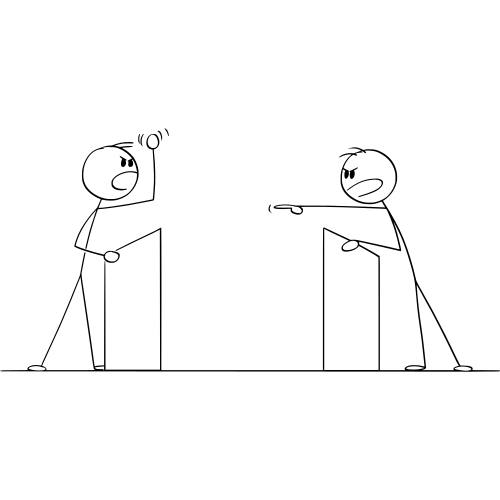
The reason for this monumental showdown, you ask?
Well, both titans discovered they were summoned to, Dean Dr. Cortex Insular’s plush offices, so as to be informed that they had both been invited to become columnists for a prestigious academic journal THE SMITH CLINIC NEWSLETTER.
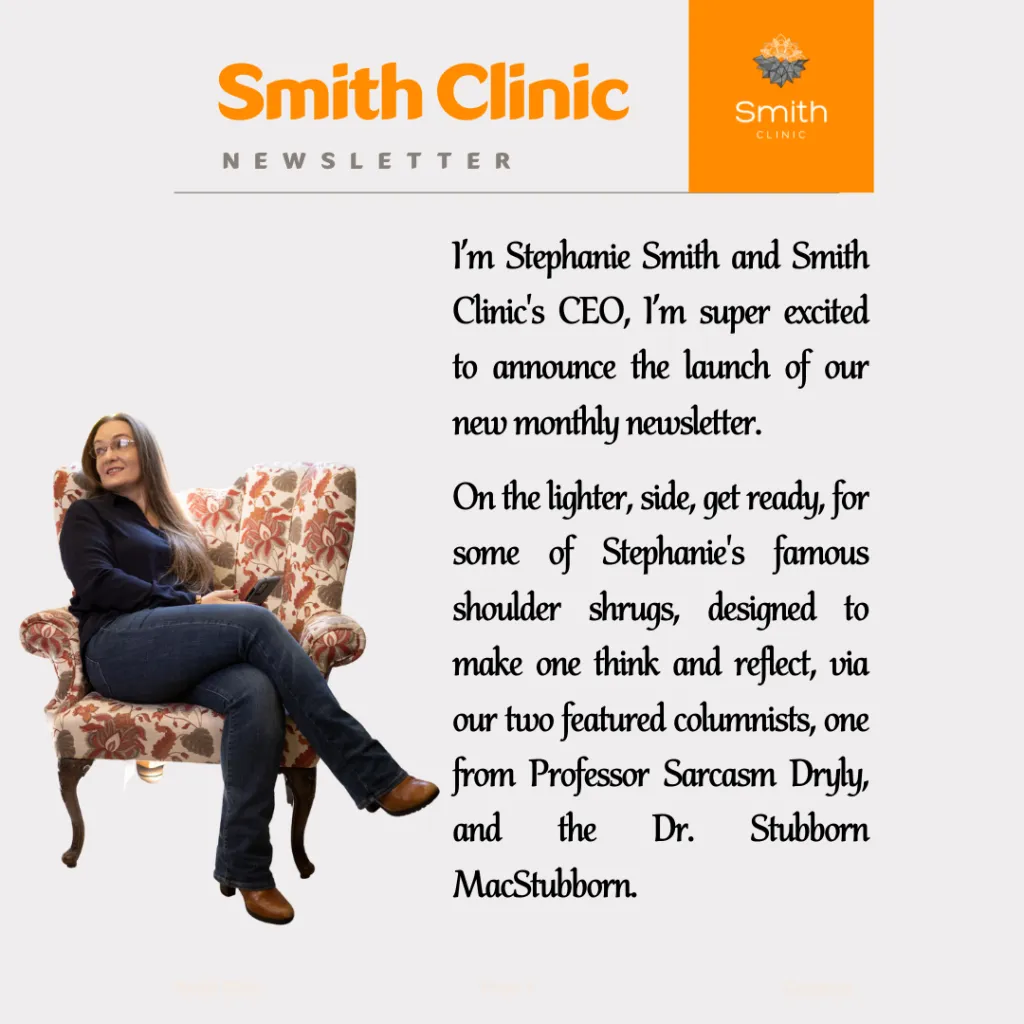
Dean Dr. Cortex Insular said “University of Wit n Cheek were being offered a truly unparalleled opportunity to show case not one, but two, exceptional psychologists and academics”, he carried on, not noticing the thunderous black thoughts, and stabbing looks, that the two titans were exchanging before his very eyes.
“It is a recognition of our excellence to be invited to delve and contribute to this esteemed world-renowned knowledge hub. This represents a monumental step in our commitment to academic excellence and intellectual exploration.” He finally stopped, looked at the two titans in front of him, and realizing that he could cut the atmosphere with a knife, and said, whilst simulatously frantically scribbing a WhatsApp message to the Universities head waiter to remove all knifes, forks, and actually, lets make it spoons, too just to be on the safe side, “You will NOT disappoint me and you will call a truce for the duration of the time you are writing about your latest research. I want 200 words on the subject by 14:00 today, please turn it into the NITIN Ai to check for Hat bgt before the 14.00 deadline, use your own words, please.”
Thus issuing a challenge that would test their mettle and push their intellectual prowess to the limit.
Dr. MacStubborn, known for his unwavering commitment to the principles of cognitive inflexibility, strode out of the room with a determined glint in his eye. “Ah, the ‘why’ question,” he mused, his voice dripping with confidence. “A true test of mental agility and adaptability. I shall conquer this challenge easily!”
Professor Dryly, lounging against the wall with an air of nonchalance, raised an eyebrow at his opponent’s bravado. “Oh, how utterly thrilling,” he drawled, his voice laced with sarcasm. “I’m sure your groundbreaking insights into toddler inquisitiveness will have the academic world trembling with anticipation.”
As the two titans sized each other up, the tension in the hallowed hall was palpable. Dr. MacStubborn, undeterred by his rival’s sarcastic barbs, launched into a passionate defense of the ‘why’ question as a crucial tool in developing cognitive inflexibility. “You see,” he declared, “the constant questioning of toddlers is not a mere annoyance, but a vital exercise in building adaptable thinking patterns. It is through this relentless interrogation that young minds learn to navigate the complexities of the world!”
Professor Dryly, unimpressed by his opponent’s fervor, countered with a sarcastic riposte. “Ah yes, the noble pursuit of driving parents to the brink of insanity. Truly, a worthy endeavor for the brightest minds of our generation.”
I will not bore you with the details of what soon became infantile but rest assured that Professor Dryly, used his own arsenal of wit and irony, whilst, Dr. MacStubborn used all of his inflexibility and stubborness to counter the sarcasm.
The result of this serendipitous encounter?
In the end, it was a battle with no clear victor. Both titans emerged from the fray with a newfound determination to write the best 200 words they had ever produced in their illustrious academic careers.
As they left the hallowed halls room, battered but unbroken, Professor Dryly couldn’t resist one final jab. “Well, Dr. MacStubborn,” he smirked, “I look forward to reading your no doubt scintillating treatise on the joys of toddler interrogation.” Dr. MacStubborn, his spirit undiminished, shot back, “And I, Professor Dryly, eagerly await your sarcastic musings on the depths of juvenile curiosity.”
Despite their differing perspectives, both Dr. MacStubborn and Professor Dryly recognized the significance of their research and the opportunity to share it with a broader audience. But the academic world as we know it, would never be the same.
Do you want to read about their research? Carry on to the next posts.
Stubborn Curiosity: The Unexpected Cognitive Benefits of Toddlers’ Incessant “Why?” Questions
The Unexpected Cognitive Perks of Sarcasm: A Witty Path to Enhanced Creativity
References
Smith, S. J. (2023). The Importance of Interdisciplinary Collaboration in Academia. Smith Clinic Journal, 42(3), 123-135.
Diamond, A. (2013). Executive functions. Annual Review of Psychology, 64, 135-168. https://doi.org/10.1146/annurev-psych-113011-143750
Frazier, B. N., Gelman, S. A., & Wellman, H. M. (2009). Preschoolers’ search for explanatory information within adult-child conversation. Child Development, 80(6), 1592-1611. https://doi.org/10.1111/j.1467-8624.2009.01356.x
Huang, L., Gino, F., & Galinsky, A. D. (2015). The highest form of intelligence: Sarcasm increases creativity for both expressers and recipients. Organizational Behavior and Human Decision Processes, 131, 162-177. https://doi.org/10.1016/j.obhdp.2015.07.001
Legare, C. H. (2014). The contributions of explanation and exploration to children’s scientific reasoning. Child Development Perspectives, 8(2), 101-106. https://doi.org/10.1111/cdep.12070
Pexman, P. M., & Glenwright, M. (2007). How do typically developing children grasp the meaning of verbal irony? Journal of Neurolinguistics, 20(2), 178-196. https://doi.org/10.1016/j.jneuroling.2006.06.001
Recchia, H. E., Howe, N., Ross, H. S., & Alexander, S. (2010). Children’s understanding and production of verbal irony in family conversations. British Journal of Developmental Psychology, 28(2), 255-274. https://doi.org/10.1348/026151008X401903
https://cadey.co/articles/cognitive-inflexibility
https://pmc.ncbi.nlm.nih.gov/articles/PMC10881749
https://www.yorku.ca/ncepeda/publications/DW2015.pdf
https://pubmed.ncbi.nlm.nih.gov/26343956
https://www.nature.com/articles/s41598-022-18231-7
https://www.foothillsacademy.org/community/articles/cognitive-inflexibility
https://www.nature.com/articles/s41598-022-18231-7
https://www.wiseworld.ai/blog/inflexibility
https://www.johnpaulcaponigro.com/blog/19403/28-great-quotes-inflexibility
https://www.scientificamerican.com/article/the-surprising-benefits-of-sarcasm
https://www.goodreads.com/quotes/1284197-sarcasm-is-the-lowest-form-of-wit-but-the-highest


By Stephanie with AI & OI
from the University of Wit & Cheek.
