
In a spectacle that can only be described as a psychological cage match, the hallowed halls of the University of Wit and Cheek recently played host to the most anticipated therapeutic showdown of the year. The Jungian Therapists Department and the Systemic Therapists engaged in a verbal sparring match that left attendees both enlightened and slightly befuddled.
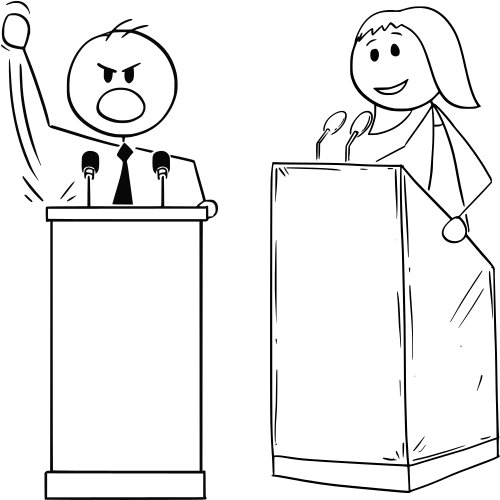
The debate, presided over by the esteemed Chair of the Department of Irony, Professor Sarcasm Dryly, promised to be an evening of intellectual rigor and thinly veiled professional rivalry. True to form, it delivered on both counts with the precision of a well-timed Freudian slip.
Dr. Anima Collective, representing the Jungian faction, opened the proceedings with a stirring defense of archetypal theory. “Our unconscious is not just a dustbin for repressed thoughts,” she declared, her voice resonating with the gravitas of a thousand collective dreams. “It’s a treasure trove of universal symbols that guide our very existence.” One could almost hear the distant echo of Jung’s approval – or perhaps it was just the creaking of the ancient auditorium chairs.
Not to be outdone, Dr. Family Genogram countered for the Systemic team with a rebuttal that was as pointed as a star. “While our esteemed colleagues are busy decoding dreams, we’re out here in the real world, untangling the very fabric of family dynamics,” he quipped, his eyebrow arched in a perfect isosceles triangle of skepticism.
The debate reached its zenith when the topic of therapeutic efficacy arose. Dr. Collective cited a study by Keller et al. (2006), stating, “Jungian therapy has shown significant improvements in symptoms, interpersonal problems, and personality structure, with effects stable over six years”.
The Jungian contingent nodded sagely, their collective unconscious practically vibrating with validation.
Dr. Genogram, however, was quick to retort. “That’s all well and good,” he said, his voice dripping with the kind of condescension usually reserved for discussing Freud at a feminist book club, “but our recent meta-analysis shows systemic therapy as a beneficial treatment option for children and adolescents with certain mental disorders, even when compared to the mighty CBT”.
The systemic supporters exchanged knowing glances, their family systems momentarily aligned in smug satisfaction.
As the debate raged on, covering everything from the merits of sand play to the intricacies of circular questioning, the audience was treated to a masterclass in psychological one-upmanship.
In a moment of unexpected unity, both sides agreed that their respective approaches were vastly superior to the “simplistic cognitive restructuring” of CBT. This brief alliance was met with such enthusiastic applause that several attendees later reported experiencing spontaneous individuation.
As the evening drew to a close, Professor Dryly summarized the proceedings with his characteristic wit. “We’ve witnessed a true meeting of minds tonight,” he drawled, “or perhaps a collision of complexes. Either way, I’m sure we can all agree that the real winner here is the field of psychotherapy – and, of course, the pharmaceutical industry.”
In conclusion
In conclusion, while no clear victor emerged from this intellectual gladiatorial contest, one thing became abundantly clear: in the world of therapeutic approaches, the only constant is change – perhaps the enduring human capacity for self-importance and of course the vast superiority of any theoretical line over the “simplistic cognitive restructuring” of CBT.
References |
Jungian | Systemic Debate
Keller, W., et al. (2006). Efficacy of Jungian Psychotherapy: Retrospective Studies.
Systemic therapy in children and adolescents with mental disorders. BMC Psychiatry, 2024.
https://www.ncbi.nlm.nih.gov/pmc/articles/PMC4217606/
https://positivepsychology.com/best-therapy-quotes/
https://pubmed.ncbi.nlm.nih.gov/25379256/
https://jungiancenter.org/jung-on-doctors/
Evidence Based Research and Jungian Psychotherapy
https://bmcpsychiatry.biomedcentral.com/articles/10.1186/s12888-024-05556-y
https://nibmehub.com/opac-service/pdf/read/Current%20Psychotherapies-%20Danny%20Wedding-%20Raymond%20J.%20Corsini-11ed.pdf
https://www.researchgate.net/publication/348174304_The_issue_of_therapists%27_cooperation_in_the_systemic_and_psychoanalytic_approach


By Stephanie with AI & OI
from the University of Wit & Cheek.
