
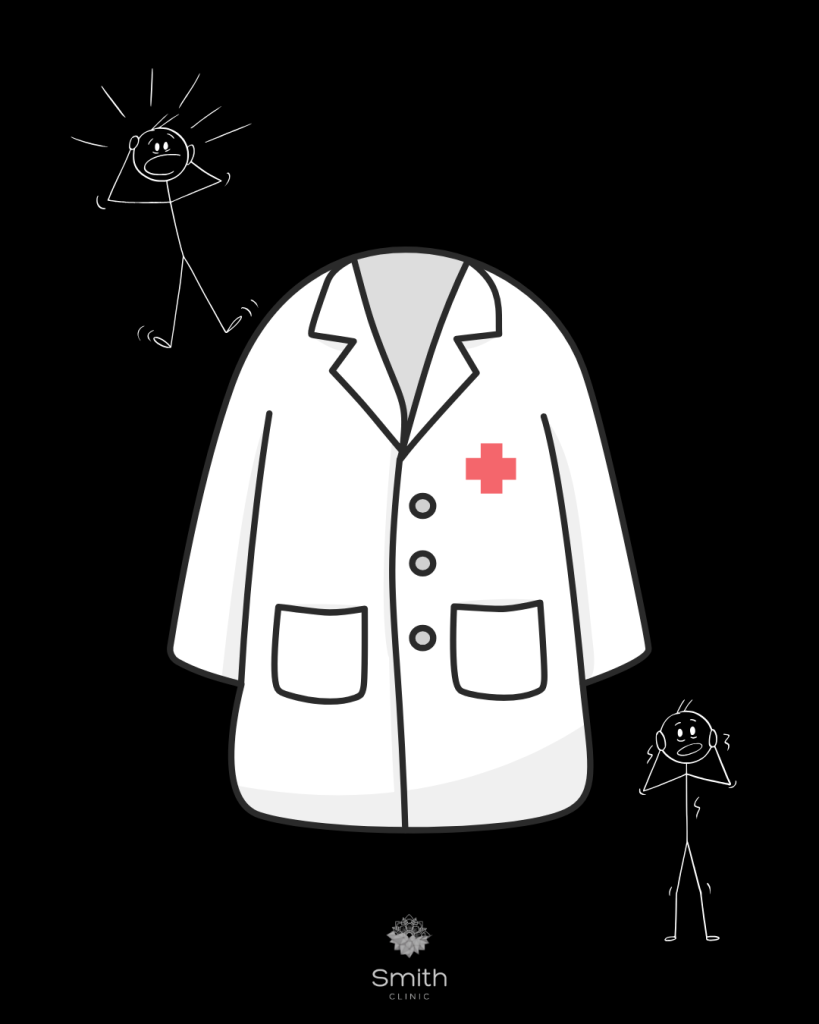
White Coat Syndrome – Fear Series
White Coat Syndrome: Why Do So Many People Feel Anxious at the Doctor’s Office?
Have you ever felt your heart race just by walking into a doctor’s office? Or noticed your blood pressure spike when it’s being measured — even though you’re not sick?
If so, you’re definitely not alone.
That nervous feeling has a name: white coat syndrome. And yes, it’s more common than you might think.
What is it, exactly?
It’s a type of anxiety that shows up specifically in medical settings. A person walks in for a check-up and suddenly: sweaty palms, racing heart, shallow breathing, even feeling faint — all without any actual illness.
The name comes from the classic white coat worn by health professionals — a symbol that, for many people, brings back not-so-great memories: needles, pain, tests, scary diagnoses, hospital stays, or even that dreaded childhood vaccination day.
But why does this happen?
There are a few common reasons:
- A bad experience at a previous appointment
- Fear of pain or needles
- General anxiety that gets worse in clinical settings
- Fear of getting bad news — even if there’s no real reason to expect it
The body reacts as if there’s a real threat, going into “alert mode.” That’s where the physical symptoms come from.
What are the signs?
Aside from emotional discomfort, white coat syndrome can actually interfere with your medical results. Blood pressure readings, for example, may go up just from the stress of being there — which can lead to misdiagnosis or unnecessary treatment.
Can you do something about it?
Yes! A few simple strategies can help:
If the anxiety feels overwhelming, consider talking to a therapist to explore and manage the root of those feelings.
Talk to your doctor about how you’re feeling. Many professionals today are trained to handle this kind of anxiety with care.
Practice deep, slow breathing to calm your nervous system.
Bring someone you trust with you. Just having support can make a big difference.
References
1. Cleveland Clinic. (2024). 7 Myths (and the Facts) About ADHD.
2. Counseling Center Group. (2024). Debunking Common ADHD Misconceptions: The Truth Revealed.
3. MSD Manuals. (2024). Clearing Up the Most Common Myths About Autism Spectrum Disorder.
4. University of Utah Health. (2024). Why Is Adult ADHD on the Rise?
5. Bupa UK. (2024). Debunking eight misconceptions about autism spectrum disorder.
6. WebMD. (2024). Autism Myths and Facts.
7. Ambitious About Autism. (n.d.). 10 misconceptions about autism.
8. Nevada Autism Treatment Assistance Program. (n.d.). Autism Myths and Misconceptions.
9. Autism Speaks. (2023). Autism statistics and facts.
10. Centers for Disease Control and Prevention. (2024). Data and Statistics on Autism Spectrum Disorder.
Sources
Clearing Up the Most Common Myths About Autism Spectrum Disorder https://www.msdmanuals.com/home/news/editorial/2024/08/15/15/17/clearing-up-the-most-common-myths-about-autism-spectrum-disorder
Myths & Facts about Autism Spectrum Disorder https://www.kennedykrieger.org/stories/myths-facts-about-autism-spectrum-disorder
Debunking 8 Autism Myths and Misconceptions https://health.clevelandclinic.org/autism-myths-and-misconceptions
Facts About Autism: Comprehensive Overview for 2024 https://abacustherapies.com/facts-about-autism-comprehensive-overview-for-2024/
Debunking eight misconceptions about autism spectrum disorder https://www.bupa.co.uk/newsroom/ourviews/misconceptions-about-autism
Autism Myths and Facts – WebMD https://www.webmd.com/brain/autism/features/autism-myths-facts
10 misconceptions about autism https://www.ambitiousaboutautism.org.uk/about-us/media-centre/blog/10-misconceptions-about-autism
[PDF] Autism myths and misconceptions – ADSD (nv.gov) https://adsd.nv.gov/uploadedFiles/adsdnvgov/content/Programs/Autism/ATAP/Autism%20Myths%20and%20Misconceptions.pdf
Autism statistics and facts | Autism Speaks https://www.autismspeaks.org/autism-statistics-asd
Data and Statistics on Autism Spectrum Disorder – CDC https://www.cdc.gov/autism/data-research/index.html

the Clinical Insights Blog by Stephanie and edited by Michael
With A little AI and OI | @smithclinic.eng

