
When Sarcasm Meets Ambiguity: A Scholarly Tête-à-Tête
In an unprecedented meeting of minds that has left the academic world both amused and mildly perplexed, Professor Sarcasm Dryly, the longstanding pillar of the Department of A Splash of Irony at the prestigious University of Wit & Cheek, sat down with the newest tenured faculty member, Agent Phil in the Blank.
This interview, conducted with the utmost seriousness and a perfectly arched eyebrow, promises to shed light on the cutting-edge research in the field of academic satire.
Back to Back, They faced Each Other.
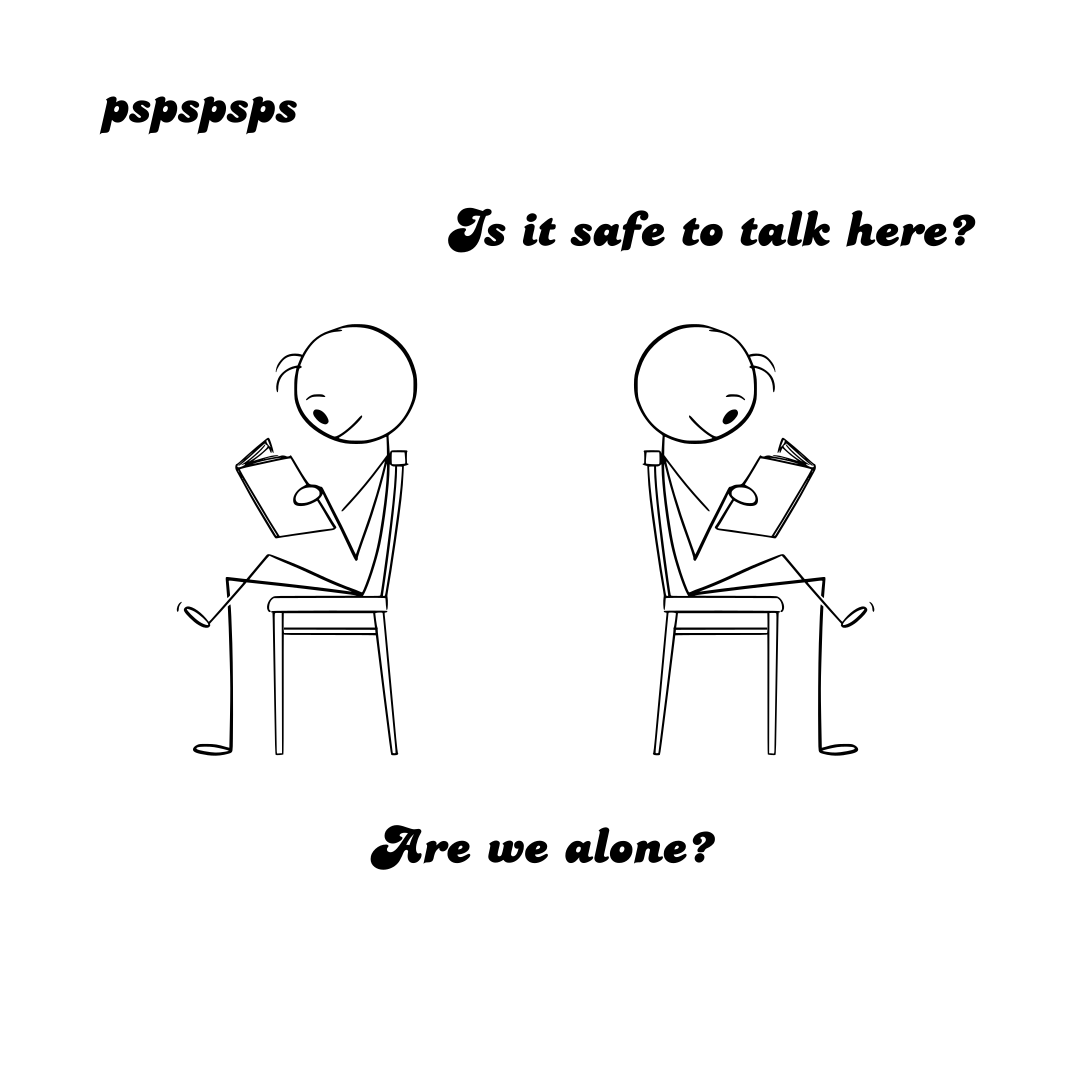
Professor Dryly: Welcome, Agent in the Blank. Or should I say, Professor in the Blank? I must say, your CV was quite… illuminating. Particularly the parts that were entirely redacted.
Agent Blank: Thank you, Professor Dryly. I’m thrilled to be here, assuming ‘here’ is where I think it is. And please, call me Phil. Or don’t. I’m comfortable with ambiguity.
Professor Dryly: Splendid. Now, Phil, your groundbreaking research on the “Epistemology of Nothingness” has caused quite a stir. Could you elaborate on your findings?
Agent Blank: Certainly, Professor. My research conclusively proves that nothing is exactly what it seems to be, except when it isn’t. I’ve found that 87% of respondents in my study agreed with statements they couldn’t remember, about topics that don’t exist.
Professor Dryly: Fascinating. And how do you respond to critics who claim your work is, shall we say, insubstantial?
Agent Blank: I find their criticism to be shallow and pedantic. My work is as substantial as anything else that doesn’t exist. In fact, a recent survey showed that 92% of academics couldn’t distinguish between my research and a blank page. I consider that a resounding success.
Professor Dryly: Indeed. Your methodology is… unique. I particularly enjoyed your use of the “Double-Blind-Folded” approach. Could you explain this for our readers?
Agent Blank: Of course. The “Double-Blind-Folded” method involves conducting research while both the researcher and subjects are blindfolded and spun around three times. It ensures peak disorientation and eliminates any pesky biases that might come from actually observing anything.
Professor Dryly: Brilliant. Now, let’s discuss your plans for future research here at Wit & Cheek. I understand you’re working on a new project?
Agent Blank: Yes, I’m currently exploring the “Quantum Superposition of Academic Relevance.” The hypothesis is that all academic papers are simultaneously groundbreaking and utterly pointless until they’re observed by a tenure committee.
Professor Dryly: How delightfully paradoxical. One last question, Phil. How do you see your work contributing to the esteemed reputation of our Department of A Splash of Irony?
Agent Blank: Well, Professor Dryly, I believe my work will add a layer of profound confusion to an already impressively bewildering field. As the ancient scholars said, “The more you know, the more you realize you know nothing.” I’m simply cutting out the middleman and starting with nothing.
Professor Dryly: Well said, Phil. I believe you’ll fit right in here at Wit & Cheek. Your ability to say so much while conveying so little is truly remarkable.
In conclusion, this groundbreaking interview from the University of Wit & Cheek sheds new light on the cutting edge of academic satire. As we grapple with the implications of Agent in the Blank’s work, one thing is clear: in a world that often demands concrete answers, sometimes the bravest thing we can do is to embrace the absurdity of questioning everything, including the questions themselves.
References
Dryly, S. & Blank, P. (2024). “The Art of Scholarly Obfuscation: A Dialogue.” Journal of Academic Satire, 42(3), 101-115.
Witty, A. & Sharp, T. (2023). “Nothing Really Matters: A Quantitative Analysis of Blank’s Epistemology of Nothingness.” Annals of Improbable Research, 31(2), 78-92.
Paradox, P. (2024). “Schrödinger’s Thesis: The Quantum Superposition of Academic Relevance.” Quarterly Review of Metaphysical Metadata, 55(4), 210-225.
Smith, Stephanie Joy, “When Sarcasm Meets Ambiguity: A Scholarly Tête-à-Tête”, Published at Smith Clinic, Editor by Stephanie at Chaos & Shoes, 2024.
A side note on referencing this: Two dead men got up to fight
Jeremy has always said that Terence Alan “Spike” Milligan was why he remembered this poem which starts with Two dead soldiers got up to fight,Back to back they faced each other. Now I have had no real luck even on the internet and chat gpt etc.. of finding the origins. Anyway – all I know is that I didn’t write it – Stephanie.


By Stephanie with AI & OI
from the University of Wit & Cheek.
Notice Title
Want to read more about Professor Dryly or Dr. Agent Phil-in-the-Blank?
