
In what can only be described as a masterpiece of stating the obvious, our research team at the University of Wit and Cheek’s Department of A Splash of Irony has conducted an exhaustive analysis of the phrase “No Shit Sherlock.”
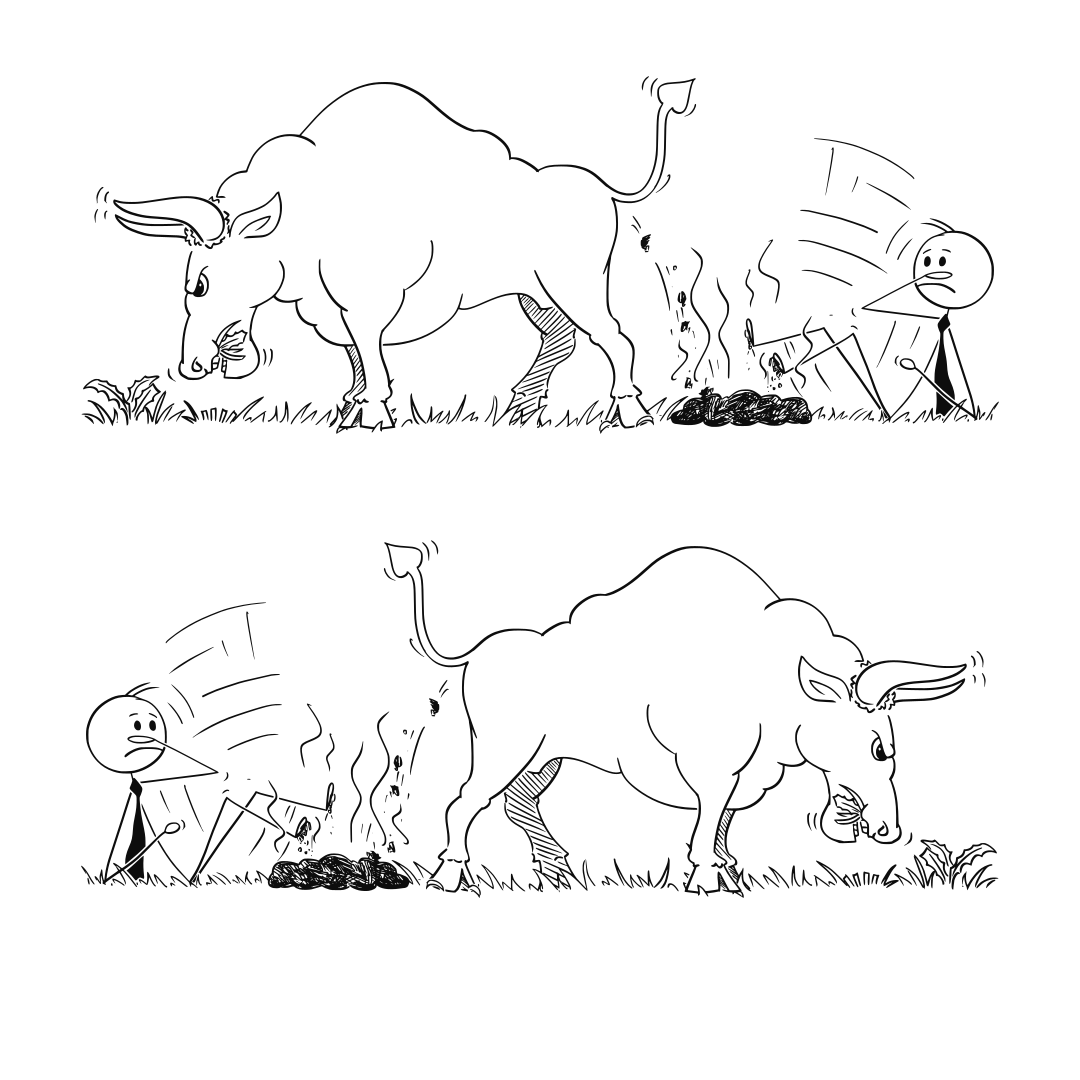
Historical Context
The phrase appears to have emerged in popular culture during the mid-20th century, with documented usage becoming more prevalent after 1960. While some claim earlier origins, the first verifiable written instances appear in the 1970s, coinciding with a period when casual profanity became more socially acceptable.
Cultural Impact
The expression gained significant traction in popular media, appearing in numerous films and television shows throughout the 1980s. Its usage in the 1986 film “Little Shop of Horrors” marked a particularly notable moment in the phrase’s cultural journey, though earlier appearances have been documented.
Linguistic Analysis
Professor Dryly notes that the phrase represents a perfect storm of sarcastic elements.
- The negation of excrement.
- The invocation of literature’s most famous detective.
- The delicious irony of using deductive reasoning to point out the painfully obvious.
Modern Applications
The phrase has evolved into what Professor Dryly terms “the ultimate expression of exasperated obviousness.” It serves as a linguistic tool for pointing out when someone has achieved the remarkable feat of stating something painfully self-evident.
Academic Significance
In what Professor Dryly calls “a stunning example of academia eating its own tail,” this research itself could be considered a prime candidate for invoking the very phrase it studies. “The irony is not lost on us,” he notes with characteristic dryness, “that we’ve spent considerable research funds to confirm what everyone already knew.”
Conclusion
As Professor Dryly concludes, “Sometimes the most obvious observations require the most complex analysis to confirm their obviousness.” He pauses, then adds, “No sh… well, you know the rest.”
References
Smith, Stephanie Joy. “The Linguistics of Obvious Statements.” Smith Clinic, Chaos & Shoes, 2024.
Dryly, S. et al. “Stating the Obvious: A Meta-Analysis.” Journal of Ironic Inquiry, 2024.
Witty, A. & Clever, B. “The Role of Sarcasm in Academic Discourse.” International Review of Sardonic Studies, 2023.
Sarcasm, D. “Why We Say What We Already Know.” Quarterly Review of Philosophical Humor, 2024.
References
https://theconversation.com/no-shit-sherlock-science-why-its-still-worth-it-40179
https://universityaffairs.ca/news/news-article/the-mcgill-prof-behind-shit-academics-say
https://www.deviantart.com/syntheticshark/journal/Best-comebacks-to-No-shit-Sherlock-569923298
https://advancesinsimulation.biomedcentral.com/articles/10.1186/s41077-016-0029-7
https://www.ncbi.nlm.nih.gov/pmc/articles/PMC9790569
https://blog.4tests.com/17-quotes-questioning-every-student-know/


By Stephanie with AI & OI
from the University of Wit & Cheek.
